
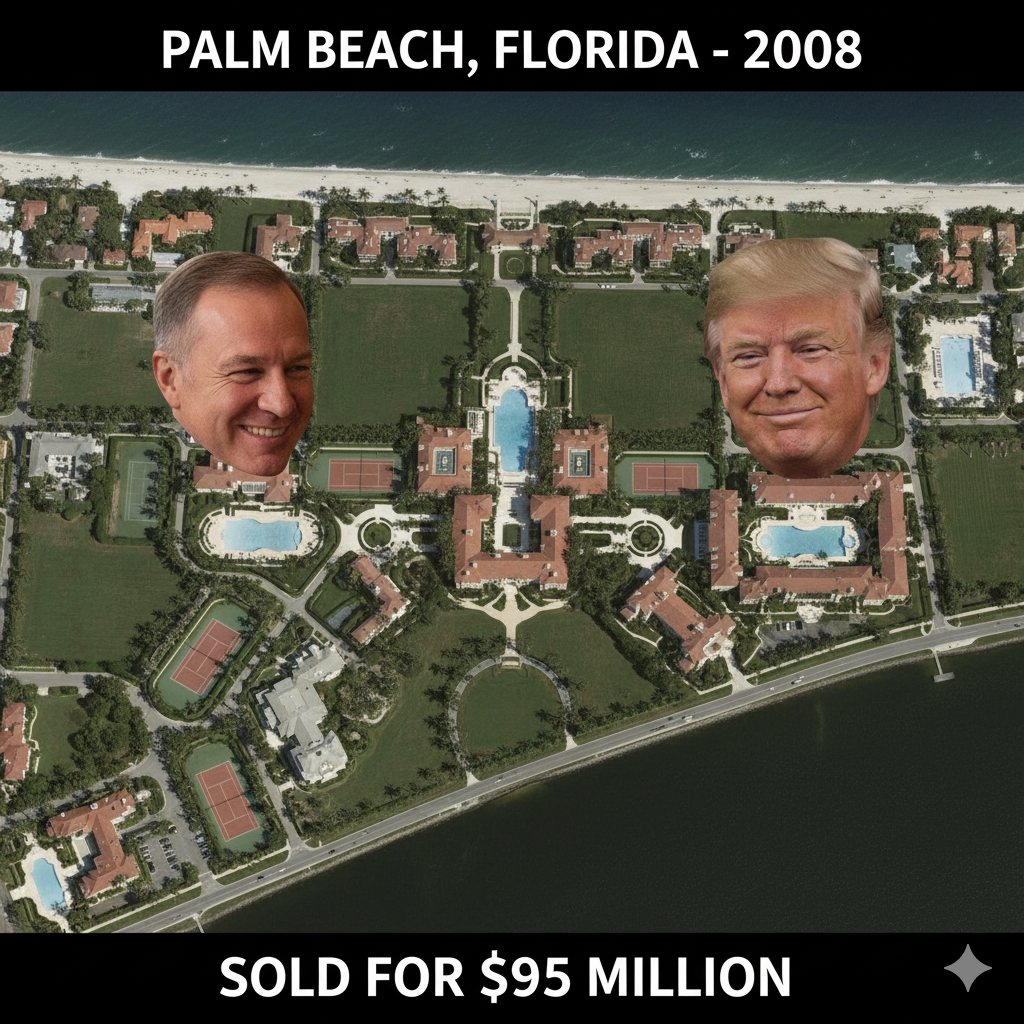
Donald Trump’s record-breaking sale of his Palm Beach mansion in 2008 to Russian fertilizer billionaire Dmitri Rybolovlev ended in one of the most infamous “tear-downs” in U.S. luxury real estate—driven in part by serious mold and building problems that made the house more liability than trophy.
In 2008, Rybolovlev bought Trump’s oceanfront Palm Beach estate, Maison de L’Amitié, for $95 million—a record price at the time for a single-family home in the United States. The massive property, sitting on roughly 6.2 acres with direct Atlantic frontage, was marketed as the ultimate status symbol, with a ballroom, guest houses, a huge pool complex, and over-the-top finishes. Trump had purchased it only a few years earlier, heavily remodeled it, and then flipped it for an enormous profit.
But the property that was once a symbol of excess soon became known for something far more ordinary and destructive: mold and building issues. Reports from local journalists and real estate sources later described persistent mold problems and difficulty maintaining proper air conditioning in the huge retreat.
Within less than a decade, Rybolovlev’s trust chose not to live in or restore the home, but to demolish it entirely and subdivide the land—turning one of America’s priciest mansions into a very expensive tear‑down.
This story is a useful case study in how even ultra-luxury properties can suffer from the same mold and moisture problems that plague ordinary homes, and why ignoring building science can turn a dream property into a very costly lesson.
Background: Trump, Rybolovlev, and Maison de L’Amitié
Donald Trump bought the Palm Beach estate in 2004 from health care executive Abe Gosman for about $41.4 million, then invested in renovations and put it back on the market for as much as $125 million.
The main house was enormous—variously reported around 61,000–62,000 square feet—with multiple outbuildings, including a carriage house, pool house, and tennis house. It was known as Maison de L’Amitié, or “House of Friendship,” and sat on a rare stretch of ocean-to-lake frontage on North County Road.
In July 2008, a Rybolovlev-controlled entity, County Road Property LLC, purchased the estate from Trump for $95 million, after Trump reduced his asking price from $100 million.
The sale was roughly $13 million above the previous top sale in Palm Beach and represented an enormous premium for a property that had lingered on the market. Rybolovlev publicly described the purchase as a real estate investment by a company in which he had an interest and said he did not intend to live in the United States.
Despite the record price, Rybolovlev and his family reportedly never actually moved into the mansion and are believed to have visited only rarely, if at all. Over the next several years, the property figured into his highly public divorce proceedings, while carrying costs such as millions in property taxes accumulated.
Behind the scenes, however, another issue was surfacing: the house itself had serious condition problems, including mold.
Mold and Building Problems at the Mansion
Local reporting and later summaries noted that the mansion had persistent mold and was hard to properly air condition, especially given its size and design. Journalist José Lambiet, who toured the property in 2007, described numerous shortcuts and flaws—such as thin “bulletproof” windows and gold-colored fixtures that were only painted—along with ongoing mold concerns.
Real estate sources reported that after Rybolovlev’s purchase, discovery of significant mold contamination changed plans for the estate and helped push the decision to demolish rather than rehabilitate the structure.
According to a Miami Herald account, one reason Rybolovlev never occupied the home was a “terrible mold problem,” which would have made it both unpleasant and potentially unhealthy to live in without extensive remediation.
By 2013, his representatives and planners were already moving toward tearing down the main house and redeveloping the land into smaller lots. In 2016, the Palm Beach Architectural Commission and Town Council approved demolition of the mansion and related structures, clearing the way for the estate to be completely removed and the property subdivided into three parcels.
In effect, a property that had sold for $95 million became, in building terms, a teardown with land value only.
Real estate commentators have called it one of the most expensive tear-downs in the country, with mold and design defects cited as key reasons that renovation did not make sense.
For readers, the key lesson is simple: mold is more than a stain on drywall—it is a symptom of water and design problems that can undermine even the most expensive structures. Paying attention to leaks, humidity, HVAC design, and building details is not optional maintenance; it is essential risk control that protects health, preserves property value, and avoids the kind of costly outcome seen at Maison de L’Amitié.
Whether someone owns a modest home or manages a luxury estate, taking mold and moisture seriously early on is far cheaper than facing a “$95 million tear-down” later.
SOURCES:
-
Palm Beach Post: “Cerabino: How a $95M Palm Beach mega-mansion became a …” (tear‑down, local context)
https://www.palmbeachpost.com/story/news/2016/04/05/cerabino-how-95m-palm-beach/6905304007/ -
Palm Beach Post / Dayton Daily News: “Trump in Palm Beach: Why did Russian pay so much for his mansion?”
https://www.daytondailynews.com/business/trump-palm-beach-why-did-russian-pay-much-for-his-mansion/IjTzoMcu12Tp9H02L6RimO/ -
Palm Beach Post (business/real estate): “Did the Russian who bought Trump’s Palm Beach property make money?”
https://www.palmbeachpost.com/story/business/real-estate/2019/02/17/trump-in-palm-beach-did-russian-mansion-buyer-make-money/5935080007/ -
New York Times: “Only in Palm Beach: The $95 Million Tear-Down”
https://www.nytimes.com/2016/08/28/business/only-in-palm-beach-the-95-million-tear-down.html
0 Comments