
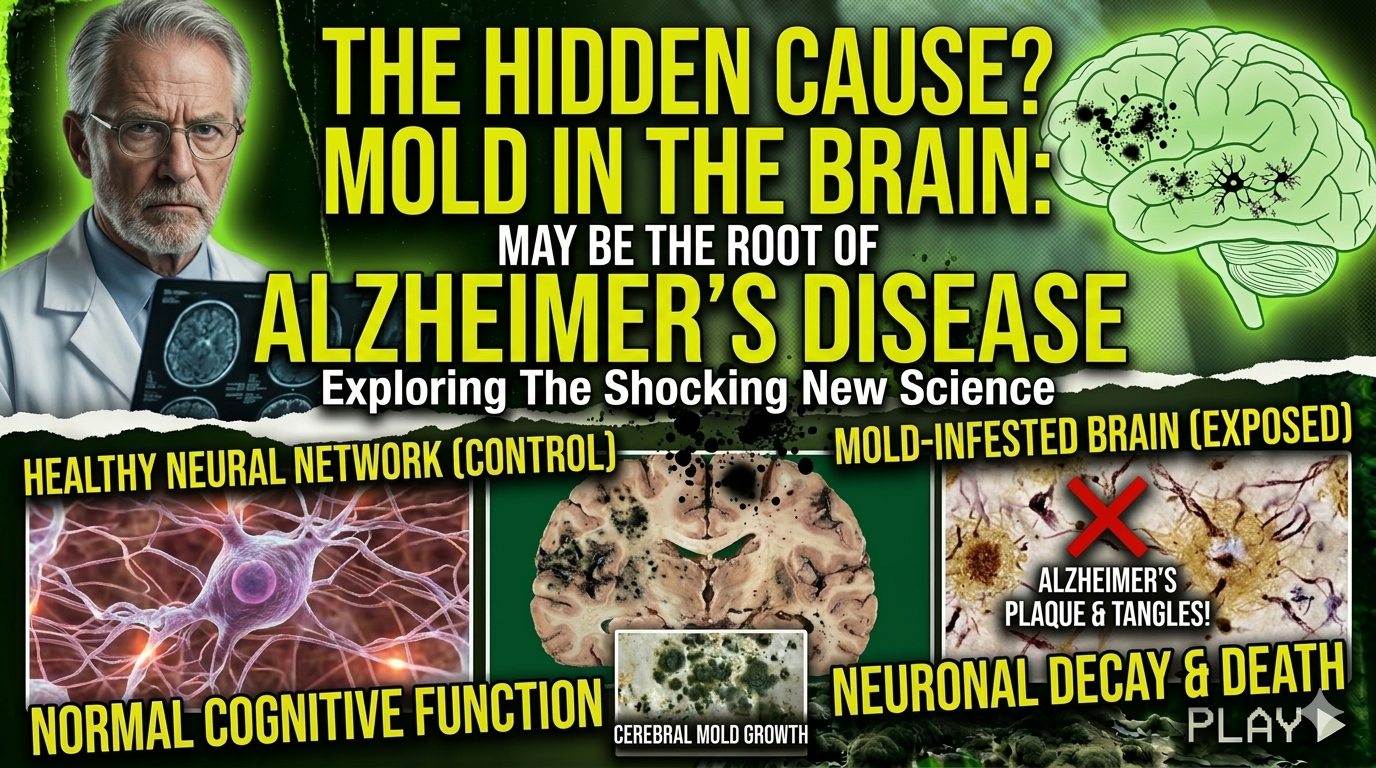
What if one of the deadliest brain diseases in human history is actually a fungal (mold) infection?
I know that sounds like a bold statement. But here’s the thing — this isn’t a new idea dreamed up on the internet.
A respected Czech neuropathologist named Oskar Fischer proposed something nearly identical over 115 years ago. And today, modern laboratory science keeps circling back to the same disturbing conclusion that Fischer reached: mold and fungi may be at the heart of Alzheimer’s disease.
Right now, over 6.9 million Americans are living with Alzheimer’s disease (AD).
Families are destroyed.
Billions of dollars in research have been spent chasing pharmaceutical solutions.
And yet the disease marches forward, with no cure in sight.
Meanwhile, studies keep piling up showing that every single Alzheimer’s patient they examine has fungi/molds growing in their brain — while none of the healthy control subjects do.
Not some.
Not most.
Every. Single. One!
I have spent years investigating mold illness, talking to people who suffer from it, and living through parts of it myself. What I see in those Alzheimer’s patients — the brain fog, the memory collapse, the slow neurological deterioration — looks a lot like what happens to people with advanced, untreated mold infections. This is not a coincidence. The evidence says otherwise.
Let’s walk through what the science actually shows — starting over a century ago.
Dr. Oskar Fischer: The Man Who Saw It First
Most people know the name Alzheimer. Fewer know the name Oskar Fischer, which is a shame, because Fischer may have been closer to the truth than anyone else in the field.
In 1907, Alois Alzheimer published his landmark paper describing plaques and tangles in one case of presenile dementia. That same year, Fischer — working at the Prague school of neuropathology — described neuritic plaques in 12 cases of senile dementia. These were parallel, independent discoveries that together defined what we now call Alzheimer’s disease.
But Fischer didn’t stop at describing the plaques. He went further. He proposed a cause.
Fischer believed that foreign bodies in the brain — possibly fungi or infectious organisms — were provoking the inflammation that created those amyloid plaques. He thought he was seeing something that looked like Actinomyces-type organisms — filamentous, branching structures — embedded in the diseased brain tissue. He believed those plaques were not just markers of the disease. He believed they were a biological response to infection.
The medical establishment largely moved on. Fischer’s infectious theory was shelved. Alzheimer’s name became the headline. And for the next 100 years, the research world chased amyloid plaques and tau tangles as the primary cause of the disease, without seriously asking: what is causing the plaques to form in the first place?
Fischer asked that question in 1910. Nobody wanted to hear the answer.
2014: The First Hard Evidence of Fungi in Alzheimer’s Brains
Fast forward over a century. In 2014, a research team published a proteomic analysis that changed the conversation — or should have.
The study, titled “Fungal Infection in Patients with Alzheimer’s Disease,” used advanced protein analysis and PCR DNA testing on brain samples collected from Alzheimer’s patients after death. What they found was striking.
According to the published results: “A proteomic analysis provides compelling evidence for the existence of fungal proteins in brain samples from Alzheimer’s disease patients. Furthermore, PCR analysis reveals a variety of fungal species in these samples, dependent on the patient and the tissue tested. DNA sequencing demonstrated that several fungal species can be found in brain samples.”
The researchers concluded that their findings represented “the first evidence that fungal infection is detectable in brain samples from Alzheimer’s disease patients”.
They were careful to note the possibility that this fungal presence could be a risk factor or a contributing etiological cause of Alzheimer’s — in plain language, that mold might be helping to start and drive the disease.
This wasn’t a fringe publication. This appeared in peer-reviewed scientific literature.
And it was just the beginning.
2015: 100% of Alzheimer’s Patients Show Fungal Infection
If the 2014 study opened the door, the 2015 follow-up study kicked it wide open.
Published in Scientific Reports (part of the Nature Publishing Group) under the title “Different Brain Regions are Infected with Fungi in Alzheimer’s Disease,” this paper examined brain tissue from multiple regions in AD patients and healthy control subjects. The regions they tested included the external frontal cortex, cerebellar hemisphere, entorhinal cortex, hippocampus, and choroid plexus.
Here’s what they found, in the researchers’ own words:
“Different brain regions including external frontal cortex, cerebellar hemisphere, entorhinal cortex/hippocampus and choroid plexus contain fungal material, which is absent in brain tissue from control individuals. Analysis of brain sections from ten additional AD patients reveals that all are infected with fungi.”
And then the number that should be on the front page of every major newspaper:
“In all eleven patients described in this study, as well as in four patients previously analysed, there is clear evidence for fungal cells inside neurons or extracellularly. Therefore, 100% of the AD patients analysed thus far by our laboratory present fungal cells and fungal material in brain sections.”
Let that sink in. One hundred percent. Not a majority. Not a strong correlation. Every single Alzheimer’s patient they examined had fungi growing in their brain. And not one of the healthy controls showed the same thing.
The fungal DNA was sequenced and identified. Multiple species were found, including Candida glabrata and other organisms. Fungal cells were found inside neurons — not just floating in the surrounding tissue, but embedded within the brain cells themselves.
Fungal hyphae — the thread-like tendrils that fungi use to grow and spread — were also detected inside blood vessels, which the researchers noted may help explain the vascular pathology commonly seen in AD patients.
A follow-up study published in Frontiers in Aging Neuroscience in 2018 confirmed these findings, providing further evidence that disseminated fungal infections are implicated as causative agents or as risk factors for AD.
This is not a statistical anomaly. This is a pattern.
The Science Behind How Mold Destroys the Brain
To understand how fungi could cause Alzheimer’s, you need to understand what mycotoxins actually do to the brain.
Mycotoxins are the toxic chemical compounds that molds produce — the biological weapons that mold uses to compete with other organisms in its environment. When humans breathe in or ingest these toxins, they can pass through the blood-brain barrier and begin doing serious damage inside the central nervous system.
A 2025 review published on PubMed lays out the mechanism in clinical detail: “Mycotoxins penetrate the central nervous system via a compromised blood-brain barrier, which may cause oxidative stress and neuroinflammation, and can also contribute to amyloid-beta (Aβ) plaque accumulation, Tau protein hyperphosphorylation, and neurofibrillary tangle formation.”
Read that again.
Mycotoxins — the poisons produced by mold — directly contribute to:
-
Amyloid-beta plaque accumulation (the primary hallmark of Alzheimer’s)
-
Tau protein hyperphosphorylation (which forms the neurofibrillary tangles Alzheimer’s described in 1907)
-
Neuroinflammation (the chronic brain swelling seen in every Alzheimer’s patient)
-
Microglial activation (the brain’s immune cells going into overdrive and beginning to destroy healthy tissue)
The 2025 review also noted that epidemiological studies show regional variations in mycotoxin prevalence and corresponding neurodegenerative disease incidences, supporting the association between mold exposure and Alzheimer’s risk.
One publication from the Alzheimer’s Drug Discovery Foundation acknowledged that mold exposure can promote cognitive impairment through “pathogenic neuroinflammation” in vulnerable individuals.
Even researchers who stop short of declaring a direct causal link admit the biological plausibility is real and significant.
And the neurotoxic pathway doesn’t stop at amyloid and tau. Research published in IMR Press has shown that mycotoxins — including gliotoxin from Stachybotrys chartarum (black mold) — cause demyelination of nerve cells, which is the stripping of the protective coating around neurons, leading to cascading neurological damage. Mold toxins don’t just irritate the brain. They structurally dismantle it.
Hirano Bodies and the Slime Mold Connection
One of the stranger pieces of this puzzle comes from an unexpected direction — slime mold.
A 2003 study from the University of Georgia, led by cell biologist Marcus Fechheimer, discovered a structure called a “Hirano body” in a model organism derived from slime mold. Hirano bodies are abnormal protein deposits found in the brains of Alzheimer’s patients, concentrated especially in the hippocampus — the brain’s primary center for learning and memory, and the first region devastated by Alzheimer’s.
Fechheimer’s research found that these same Hirano bodies could be studied and manipulated in slime mold, giving researchers a window into their behavior.
What matters here for our discussion is the context: abnormal structures found in both fungal organisms and in the brains of Alzheimer’s patients, concentrated in the very regions where memory is first destroyed.
As James Bamburg, professor of biochemistry at Colorado State University and a collaborator on the study, noted: “Hirano bodies are certainly more prevalent in brains from patients who are suffering from dementia, probably any type. Hirano bodies also occur in brains of individuals with normal cognitive function but usually increase in number with age.”
The connection between fungi-related structures and the physical pathology of Alzheimer’s disease keeps showing up no matter where researchers look.
Mold Illness and Alzheimer’s: The Symptoms Are Almost Identical
I’ve talked to hundreds of people over the years who are suffering from mold illness.
And when I look at what they describe — compared to what Alzheimer’s patients and their families describe — the overlap is impossible to ignore.
Here’s what both groups share:
-
Progressive memory loss — both start with short-term memory failure and worsen over time
-
Word-finding difficulties — both groups struggle to recall and articulate words
-
Brain fog and cognitive dysfunction — a pervasive inability to think clearly
-
Behavioral and personality changes — irritability, anxiety, depression, social withdrawal
-
Neuroinflammation — chronic, measurable brain swelling detected on imaging
-
Immune system dysregulation — the body in a constant state of immune alarm
-
Fatigue and disorientation — severe, debilitating exhaustion that doesn’t respond to rest
The Carroll Institute, which treats mold illness patients in Florida, has documented this overlap extensively, noting that mold toxicity produces a syndrome that is “clinically indistinguishable” from early-stage Alzheimer’s in many patients.
The difference? Mold illness can potentially be treated if caught early and if the source of exposure is removed. Alzheimer’s, as currently managed by mainstream medicine, offers no cure and no reversal.
Which makes me wonder: how many people sitting in memory care units right now were exposed to a moldy building for years or decades before their diagnosis?
The Building Science Angle: Where Is the Mold Coming From?
This is where my background as a mold investigator and inspector adds another dimension to this conversation.
We know from EPA data that about 50% of American buildings have had water damage, and water damage is the primary driver of mold growth. Black mold (Stachybotrys chartarum) and other toxic species like Aspergillus, Penicillium, and Cladosporium thrive in any structure with humidity, leaks, or poor ventilation.
These molds don’t just stay in the walls. Their spores and mycotoxins become airborne. They get into HVAC systems.
They contaminate the air that building occupants breathe every single day — sometimes for years, sometimes for decades, without anyone knowing the source of their health problems.
According to the EPA: “Indoor mold growth can begin within 24 to 48 hours after water exposure.” Most homeowners don’t find out they have a mold problem until the visible signs appear — black staining on drywall, musty odors, or a health crisis that finally triggers an inspection.
By the time visible mold appears, the occupants have often been breathing mycotoxins for months or years.
Chronic low-level exposure is the most dangerous scenario because it doesn’t produce the dramatic acute symptoms that might send someone to the doctor. Instead, it slowly accumulates in fat tissue — including the brain, which is approximately 60% fat — and quietly begins its neurological work.
Mycotoxins are fat-soluble. The brain is the most fat-rich organ in the body.
These two facts together help explain why the brain is particularly vulnerable to long-term mold exposure, and why fungal organisms are found in the brain tissue of every Alzheimer’s patient tested.
The Bigger Picture: Are We Treating the Wrong Thing?
The Alzheimer’s research and pharmaceutical complex has spent decades and billions of dollars targeting amyloid plaques as the disease itself. Drug after drug has been developed to clear amyloid from the brain.
And drug after drug has failed to stop cognitive decline, even when it successfully reduces plaque levels.
Why?
One possibility that researchers are now beginning to take seriously: the amyloid plaques are not the root cause — they’re the immune response.
The brain is producing amyloid as a defense mechanism against infection. Remove the plaques while leaving the infection in place, and you’ve done nothing to address the underlying problem.
A review published in Trends in Neurosciences in 2025 posed the question directly: “What would it take to prove that a chronic infection is a causal agent of Alzheimer’s disease?” — acknowledging that accumulating evidence from bacteria, viruses, and fungi all points toward an infectious component at the root of the disease.
Fischer asked the same question in 1910. He didn’t have PCR analysis, confocal microscopy, or proteomic sequencing.
He had autopsies and a microscope.
And he still saw the mold.
What You Should Do Right Now
If you live or work in a building with a history of water damage, flooding, leaks, or musty odors — and especially if you or a family member is experiencing unexplained cognitive decline, memory problems, or neurological symptoms — take these steps immediately:
-
Get a professional mold inspection from a certified mold inspector, not just a general contractor. They should use air sampling, surface sampling, and moisture readings to identify hidden mold sources.
-
Test your air quality. ERMI (Environmental Relative Moldiness Index) testing can identify the specific species of mold in your home, including the most dangerous ones.
-
See a mold-literate physician. Most mainstream doctors are not trained in mold illness. Seek out a physician familiar with CIRS (Chronic Inflammatory Response Syndrome) or biotoxin illness.
-
Remediate the source, not just the surface. Cleaning visible mold with bleach does not eliminate the problem. Proper remediation requires removal of contaminated materials and correction of the underlying moisture source.
-
Document everything. If you suspect mold contributed to a family member’s neurological decline, keep records. This field of research is evolving rapidly, and documentation matters.
Conclusion: Mold Is the Elephant in the Room/Brain
Over 115 years ago, Oskar Fischer stood in an autopsy room in Prague and saw something strange in the brains of demented patients. He believed it was an infection.
He believed the plaques were the body’s response to foreign invaders — possibly fungi.
He was largely ignored and then murdered in a NAZI concentration camp.
In 2014 and 2015, researchers used modern molecular tools to confirm what Fischer suspected with primitive instruments: fungi are present in 100% of Alzheimer’s brain samples and zero percent of healthy control samples.
In 2025, a new generation of researchers is examining exactly how mycotoxins trigger amyloid production, tau tangles, neuroinflammation, and neuronal death — the complete biological mechanism of Alzheimer’s disease.
The evidence is there. It has been there for over a century.
It just doesn’t fit neatly into a pharmaceutical business model.
Think about how many of the millions of people who suffer from Alzheimer’s lived or worked for years in water-damaged, mold-infested buildings.
Think about how many of them reported memory problems, brain fog, and cognitive decline that their doctors attributed to “normal aging” or genetics — never once considering the building they went home to every night.
Mold is a microscopic organism that survives by consuming organic matter. It consumes wood. It consumes drywall. It consumes paper and fabric.
And when it gets inside a human body — when it colonizes the brain — it consumes that too.
Slowly.
Methodically.
Without mercy.
Just like it takes over a building.
The question is no longer whether mold belongs in the Alzheimer’s conversation.
The question is why it took this long to get there?
References
-
Alonso, R. et al. (2014). Fungal infection in patients with Alzheimer’s disease. Journal of Alzheimer’s Disease. https://pubmed.ncbi.nlm.nih.gov/24614898/
-
Pisa, D. et al. (2015). Different Brain Regions are Infected with Fungi in Alzheimer’s Disease. Scientific Reports, Nature Publishing Group. https://www.nature.com/articles/srep15015
-
Pisa, D. et al. (2018). Infection of Fungi and Bacteria in Brain Tissue From Elderly Persons and Patients with Alzheimer’s Disease. Frontiers in Aging Neuroscience. https://www.frontiersin.org/journals/aging-neuroscience/articles/10.3389/fnagi.2018.00159/full
-
Goedert, M. (2009). Oskar Fischer and the study of dementia. PMC/NIH. https://pmc.ncbi.nlm.nih.gov/articles/PMC2668940/
-
Soriano, S. et al. (2025). Mycotoxins as a potential etiological factor for neurodegenerative diseases. PubMed. https://pubmed.ncbi.nlm.nih.gov/39814257/
-
Mold and Mycotoxin Exposure. Alzheimer’s Drug Discovery Foundation / Cognitive Vitality for Researchers. https://www.alzdiscovery.org/uploads/cognitive_vitality_media/Mold-and-Mycotoxin-Cognitive-Vitality-For-Researchers.pdf
-
Mold and Mycotoxin Exposure and Brain Disorders. (2023). IMR Press / Journal of Integrative Neuroscience. https://www.imrpress.com/journal/JIN/22/6/10.31083/j.jin2206137
-
EnviroBiomics. (2024). The Potential Relationship Between Household Mold and Alzheimer’s Disease. https://www.envirobiomics.com/the-potential-relationship-between-household-mold-and-alzheimers-disease/
-
The Carroll Institute. (2025). Mold Exposure and Brain Health: A Hidden Epidemic. https://thecarrollinstitute.com/root-causes-articles/alzheimers-mold-and-brain-health-in-florida
-
ScienceDirect. (2025). What would it take to prove that a chronic infection is a causal agent of Alzheimer’s disease? https://www.sciencedirect.com/science/article/abs/pii/S0166223625001043
-
AAAS/Science.org. (2015). A Fungal Origin For Alzheimer’s? https://www.science.org/content/blog-post/fungal-origin-alzheimer-s


0 Comments