
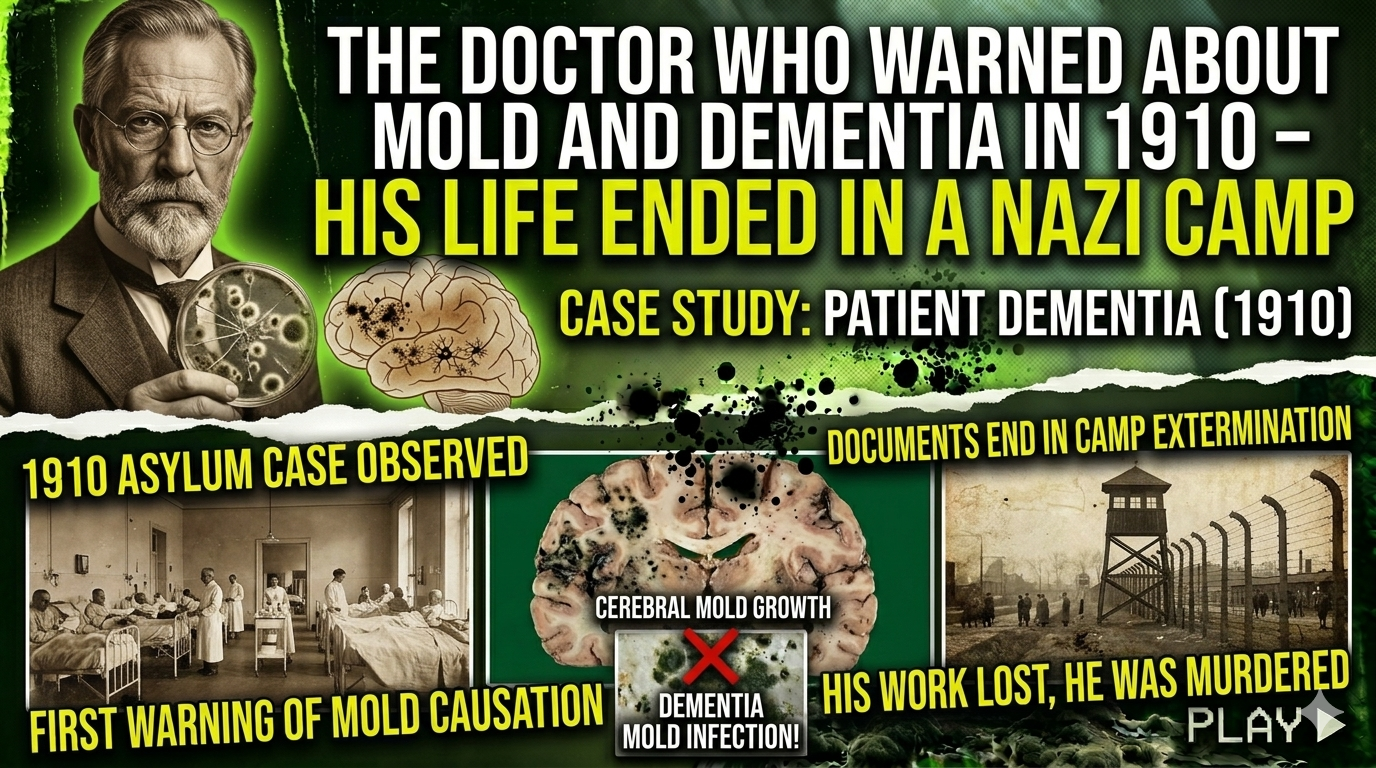
For more than a hundred years, a quiet voice in neuropathology warned that the plaques and tangles of Alzheimer’s disease might be the brain’s response to an infectious invader—specifically, fungi.
Oskar Fischer, a Czech psychiatrist and neuropathologist, first raised this idea in 1910 after observing that the abnormal structures in demented brains resembled fungal colonies. He was born in 1876 in Prague, then part of the Austro‑Hungarian Empire.
Fischer trained at the German University in Prague, where he joined the neuropathological school led by Arnold Pick, one of the founders of dementia research.
Fischer’s work placed him squarely in the same era as Alois Alzheimer, Emil Kraepelin, and other towering figures who first mapped out the pathology of mental illness.
But unfortunately, his work never saw the light of day because he was later arrested by the NAZI Gestapo and murdered in a concentration camp.
This is the lost story of Oskar Fischer – the man who warned us about mold and dementia over 100 years ago.
After earning his MD in 1900, Fischer worked at the Department of Psychiatry of the German University in Prague under Arnold Pick, a pioneer in behavioral neurology.
In his 1907 paper and its follow‑ups, Fischer essentially proposed that Alzheimer’s disease is triggered by a persistent microbial invasion of the brain, and that the plaques everyone else called “senile” were the immune system’s physical response to that infection.
These were independent, parallel discoveries that together defined the clinicopathological entity now known as Alzheimer’s disease. Fischer went further: he distinguished two disease entities—presbyophrenic dementia (associated with plaques) and simple senile dementia (without plaques)—arguing that plaques were not merely age‑related changes but a specific pathological substrate.
By 1910, Fischer had expanded his work to 275 autopsies and mapped out eight distinct stages in the development of plaques, from tiny “morning star” structures to massive cortical infiltrates.
He linked the severity of these stages to the clinical progression of dementia, arguing that the more advanced the plaques, the more severe the cognitive decline.
In his own terms, Fischer concluded that presbyophrenia (a term then used for a distinct form of dementia) was the pathological result of these infectious plaques, while other forms of senile dementia were separate diseases.
This was effectively the first recorded argument that Alzheimer’s‑type dementia is caused by an infectious agent lodged in the brain.
Fischer concluded that these structures were not just random junk.
He believed they were the product of chronic infection, possibly caused by organisms that behaved like bacteria but bore a striking resemblance to fungi—filamentous, branching structures that he likened to an “Actinomyces‑type” druse or “Alzheimer’s germ.”
Today, over a century later, modern molecular biology has started to confirm that view.
Brain tissue from Alzheimer’s patients shows fungal proteins, cells, and DNA inside neurons and brain sections, while non‑Alzheimer’s controls show none.
As we look back at Fischer’s work through the lens of contemporary mycology and neuropathology, it becomes harder and harder to dismiss. His observations were not just a side note in the history of dementia.
They were a precise early prediction of what modern science is now rediscovering: that mold and other fungi may be the hidden cause of Alzheimer’s disease.
Modern molecular biology has since confirmed his intuition: every Alzheimer’s brain examined in rigorous studies contains fungal material, while healthy controls show none.
Yet the medical establishment continues to chase amyloid‑clearing drugs that fail to stop cognitive decline, ignoring a plausible upstream cause.
The “Foreign Body” Hypothesis
Fischer did not stop at description. He speculated that the plaques resulted from “foreign bodies” in the brain, possibly infectious organisms, that provoked inflammation and amyloid deposition.
Using Bielschowsky silver staining, he noted that the mature plaques resembled the histological appearance of an actinomycosis—a filamentous bacterial infection—and coined the term Aktinomycesdruse to describe their rosette‑like structure.
This morphological analogy led him to suggest that the plaques were the brain’s response to an unseen invader, a hypothesis that aligns remarkably with modern findings of fungal proteins and DNA in Alzheimer’s tissue.
A Lifetime of Overlooked Contributions
Fischer’s theory was also dangerous in the political sense. As a Jewish physician in an increasingly hostile Europe, proposing a radical new view of a major disease made him a target for professional as well as political persecution.
When the Nazis occupied Czechoslovakia, they had little tolerance for intellectuals who did not toe the line—especially those who were both Jewish and philosophically independent.
Despite publishing extensively on dementia, cerebral tumors, and spongiform cortical atrophy, Fischer was denied tenure at the German University in 1919, a decision contemporaries found surprising given his productivity.
By the late 1930s, increasing political pressure forced him out of academia; by 1939 he was no longer allowed to teach.
His work faded into obscurity, overshadowed by Alzheimer’s name, even though many historians now argue Fischer’s contributions were at least as significant.
The Tragic End: Arrest, Imprisonment, and Murder in Terezín
Targeted by the Gestapo
In 1941, nearly three years after the German occupation of Czechoslovakia, Fischer was arrested by the Gestapo.
Although he was a Protestant, his Jewish ancestry and earlier left‑leaning sympathies made him vulnerable under Nazi racial laws.
He was deported to Theresienstadt (Terezín), a ghetto and transit camp for Jews and political prisoners destined for extermination camps.
Conditions and Death
Theresienstadt was notorious for overcrowding, forced labor, and brutal treatment. Fischer, then 65, was held in the “Small Fortress,” a prison within the ghetto used for political detainees.
Reports indicate he was beaten by guards; his death certificate from the Terezín ghetto lists the cause as “murdered” on 28 February 1942.
Some sources note he died after being beaten to death, a fate shared by many intellectuals singled out by the regime. His body was likely cremated in the camp’s crematorium, and his ashes were scattered—another effort to erase his memory.
Posthumous Recognition
After the war, Fischer’s name appeared sporadically in Czech medical histories, but the German University of Prague was dissolved in 1945, eliminating the institutional continuity that might have preserved his legacy.
Only in the 2000s did scholars such as Michel Goedert of Cambridge’s MRC Laboratory rediscover his papers in Charles University’s archives, prompting renewed appreciation for his prescient ideas.
Today, a lecture series at the University of Texas at Dell Medical School bears his name, a belated acknowledgment of the man who first linked plaques to an infectious process.
From Fischer’s Germ to Modern Fungal‑AD Research
Fast‑forward a full century. In 2014, a team led by neurovirologist Luis Carrasco and colleagues analyzed brain tissue from Alzheimer’s patients and found fungal proteins and DNA in the nervous system—not in the controls.
By 2015, the same group reported that all 11 Alzheimer’s patients they examined had fungal cells and hyphae in multiple brain regions, including the frontal cortex, hippocampus, and choroid plexus, while zero healthy controls did.
In 2018, the same researchers used next‑generation sequencing to identify fungal genera such as Candida, Malassezia, Alternaria, Botrytis, and Cladosporium in Alzheimer brains, while Fusarium dominated the controls—a different pattern entirely.
In 2022, another review summarized the “fungal model” of Alzheimer’s disease, noting that Candida, Malassezia, and other fungi induce amyloid‑beta production, neuroinflammation, and neurodegeneration in ways that mirror the classic Alzheimer’s pathology.
When you read these findings and Fischer’s 1907–1910 work side by side, the continuity is striking.
Fischer saw foreign, filamentous structures embedded in Alzheimer’s plaques and interpreted them as the mark of an infectious organism.
Modern researchers see fungal proteins, cells, and DNA inside neurons and blood vessels in the exact same regions, and increasingly frame Alzheimer’s as a chronic fungal infection of the brain.
Fischer did not live to see that confirmation. But his ghost is now staring straight out of the microscope.
Conclusion: Why Ignoring the Mold‑Alzheimer Link Costs Lives
Oskar Fischer’s 1910 insight—that plaques might be the brain’s reaction to an infectious agent—was dismissed for generations, his name all but erased by the tragedies of Nazi persecution and the postwar ascendancy of Alois Alzheimer’s eponym.
Yet a century of accumulating evidence has vindicated his core intuition: fungal cells, hyphae, and mycotoxins are present in the brains of every Alzheimer’s patient examined in rigorous studies, absent from healthy controls, and capable of triggering the exact molecular cascades that produce amyloid plaques, tau tangles, neuroinflammation, and neuronal loss.
The tragedy is twofold. First, millions of families continue to watch loved ones slip into dementia while physicians prescribe drugs that target plaques without addressing the underlying fungal provocation.
Second, countless individuals live unknowingly in mold‑infested homes, breathing toxins that silently erode their cognition, only to receive a diagnosis of “probable Alzheimer’s” when preventive action could still halt or reverse the damage.
Recognizing mold as a potential driver of Alzheimer’s does not diminish the importance of genetic or vascular risk factors; it adds a crucial, modifiable layer to the disease’s etiology. By fixing leaks, testing air quality, remediating contaminated spaces, and seeking mold‑literate medical care, we can reduce the burden of a disease that presently steals memories, independence, and lives.
Fischer died in a Gestapo prison, his voice silenced by his death.
Let us honor his scientific courage by finally listening to what his microscope saw over a hundred years ago: the brain’s plaques may be a signal, not the disease itself—and the signal may be shouting, “Fungus is here.”
References
-
Alonso, R. et al. (2014). Fungal infection in patients with Alzheimer’s disease. Journal of Alzheimer’s Disease. https://pubmed.ncbi.nlm.nih.gov/24614898/
-
Pisa, D. et al. (2015). Different Brain Regions are Infected with Fungi in Alzheimer’s Disease. Scientific Reports. https://www.nature.com/articles/srep15015
-
Pisa, D. et al. (2018). Infection of Fungi and Bacteria in Brain Tissue From Elderly Persons and Patients with Alzheimer’s Disease. Frontiers in Aging Neuroscience. https://www.frontiersin.org/journals/aging-neuroscience/articles/10.3389/fnagi.2018.00159/full
-
Goedert, M. (2009). Oskar Fischer and the study of dementia. PMC/NIH. https://pmc.ncbi.nlm.nih.gov/articles/PMC2668940/
-
Soriano, S. et al. (2025). Mycotoxins as a potential etiological factor for neurodegenerative diseases. PubMed. https://pubmed.ncbi.nlm.nih.gov/39814257/
-
Mold and Mycotoxin Exposure. Alzheimer’s Drug Discovery Foundation / Cognitive Vitality for Researchers. https://www.alzdiscovery.org/uploads/cognitive_vitality_media/Mold-and-Mycotoxin-Cognitive-Vitality-For-Researchers.pdf
-
Mold and Mycotoxin Exposure and Brain Disorders. (2023). IMR Press / Journal of Integrative Neuroscience. https://www.imrpress.com/journal/JIN/22/6/10.31083/j.jin2206137
-
EnviroBiomics. (2024). The Potential Relationship Between Household Mold and Alzheimer’s Disease. https://www.envirobiomics.com/the-potential-relationship-between-household-mold-and-alzheimers-disease/
-
The Carroll Institute. (2025). Mold Exposure and Brain Health: A Hidden Epidemic. https://thecarrollinstitute.com/root-causes-articles/alzheimers-mold-and-brain-health-in-florida
-
ScienceDirect. (2025). What would it take to prove that a chronic infection is a causal agent of Alzheimer’s disease? https://www.sciencedirect.com/science/article/abs/pii/S0166223625001043
-
AAAS/Science.org. (2015). A Fungal Origin For Alzheimer’s? https://www.science.org/content/blog-post/fungal-origin-alzheimer-s
-
Ross, J. (2026). Brain fungal infection produces Alzheimer’s disease-like changes. Cell Reports (Baylor College of Medicine). https://pubmed.ncbi.nlm.nih.gov/41513640/
-
Tanzi, R. & Moir, R. (2018). Alzheimer’s Disease-Associated β-Amyloid Is Rapidly Seeded by Herpesviridae to Protect against Brain Infection. Neuron. https://pubmed.ncbi.nlm.nih.gov/30001512/
-
Huang, Y. et al. (2022). Mycotoxin OTA Triggers Alzheimer’s Disease. ACM Digital Library. https://dl.acm.org/doi/abs/10.1145/3570773.3570835
-
Zhou, H. et al. (2025). A potential etiological factor for neurodegenerative diseases? ScienceDirect. https://www.sciencedirect.com/science/article/abs/pii/S0300483X25000125
-
Zhang, L. et al. (2024). Gut Fungi in Alzheimer’s Disease: Mechanisms, Biomarkers and …. Aging and Disease. https://www.aginganddisease.org/EN/10.14336/AD.2024.1310
-
U.S. Environmental Protection Agency. (n.d.). Mold and Health. https://www.epa.gov/mold/mold-and-health
-
Centers for Disease Control and Prevention. (n.d.). Facts About Mold and Dampness. https://www.cdc.gov/mold/dampness_facts.htm
-
World Health Organization. (2009). WHO Guidelines for Indoor Air Quality: Dampness and Mould. https://www.who.int/publications/i/item/9789241548085

0 Comments