
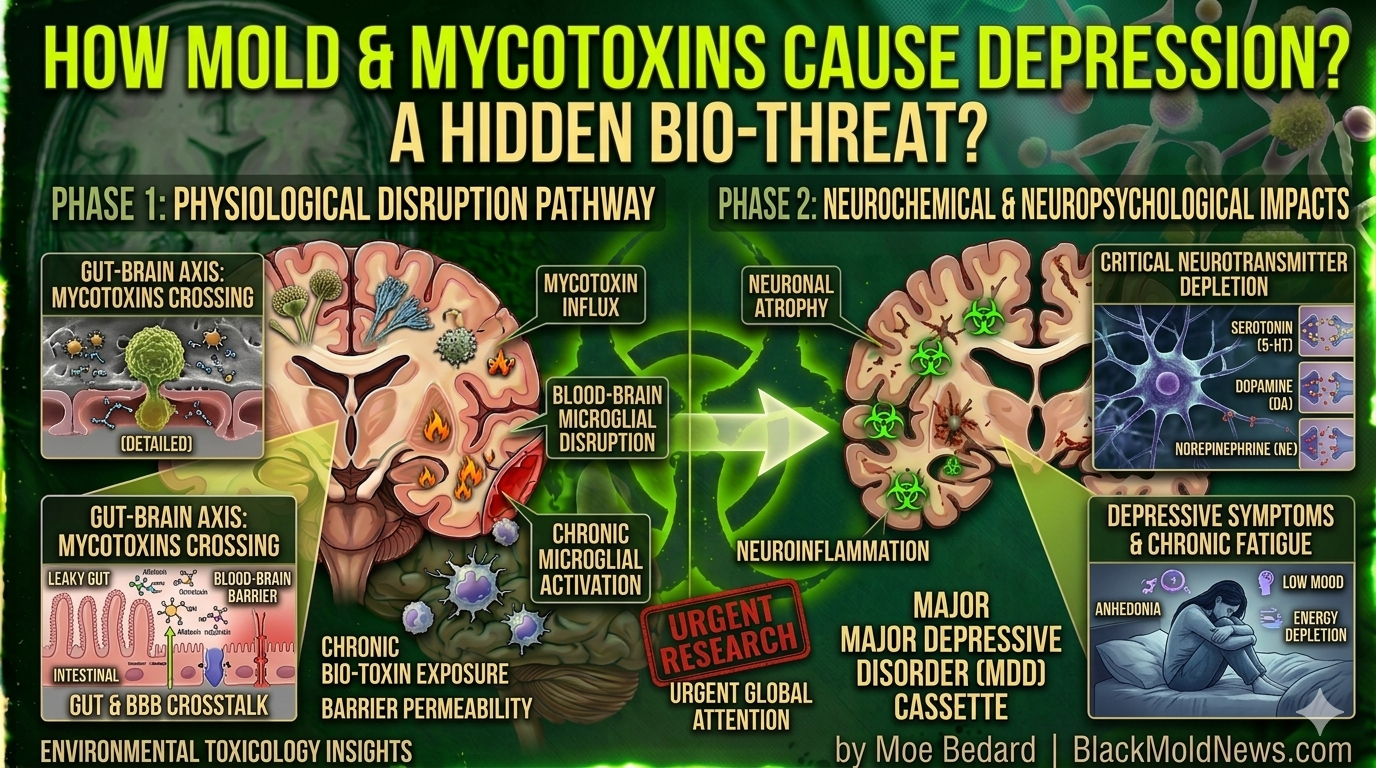
Research published in major scientific journals shows a clear link between living in damp, moldy homes and higher rates of depression, anxiety, and cognitive impairment.
A 2024 state-of-the-science review found that across 19 qualifying studies, residential dampness and mold exposure were consistently associated with poorer mental and emotional health in both adults and children.
For adults, the outcomes included depression, stress, and anxiety. For children, emotional dysregulation and behavioral symptoms were observed.
This is not pseudo science.
It is an emerging area of public health concern backed by peer-reviewed research, neurological studies, and population-level data. If you or someone you know has been struggling with unexplained depression — especially while living in a water-damaged or musty home — mold may deserve a serious look.
A recent ScienceDirect study found that that this critical public health implication:
“Our data suggest that respiratory exposure to any mold, not just the particularly toxic ones like Stachybotrys, may be capable of causing brain inflammation.”
This means that even lower-grade mold problems — not just the infamous black mold — may be enough to trigger neurological damage.
According to a Psychology Today article written by an integrative psychiatrist, toxic mold illness is a very prevalent and under-diagnosed condition that can manifest with symptoms that are exclusively psychiatric — including depression, anxiety, attentional problems, brain fog, and insomnia.
Patients with mold-related psychiatric symptoms often cycle through antidepressants and therapy without improvement, because the root environmental cause is never identified or addressed.
A landmark study published in the American Journal of Public Health and indexed at the National Institutes of Health evaluated survey data from 8 European cities.
Researchers found that dampness or mold in the home was associated with depression at an odds ratio of 1.39 to 1.44, even after controlling for individual and housing characteristics.
In plain terms: people living in moldy homes were roughly 40% more likely to experience depression than those who were not.
A 2002 neuropsychological study found a significant correlation between patients’ scores on the Beck Depression Inventory and the number of neuropsychological tests they failed — suggesting the depression seen in mold-exposed patients is linked directly to measurable brain impairment, not just emotional distress.
A 2003 review in Neurotoxicology and Teratology found that chronic exposure to toxigenic molds could lead to abnormal natural killer cell (NKC) activity — an immune dysregulation with wide-ranging neurological consequences.
- These symptoms included:
Depression and mood swings - Memory loss and brain fog
- Sleep disturbances and anxiety
- Chronic fatigue and headache
- Seizures in severe cases
The same review noted that depression and psychological stress could be induced at very low physiological concentrations of mycotoxin-driven NKC disruption.
This means you don’t need to be living in a heavily infested building to be affected — low-level, chronic exposure may be enough to alter brain chemistry over time.
A 2025 study from China reinforced these findings above on a much larger scale.
Researchers analyzed data from 9,243 elderly participants and found that those exposed to mold had more than double the odds of depression (OR = 2.26) and anxiety (OR = 2.11) compared to those without mold exposure. The co-occurrence of depression and anxiety was even higher, with an odds ratio of 2.58.
The Brain Science: How Mold Triggers Depression
Understanding why mold causes depression requires a look at how mold affects the brain at a biological level.
Brain scientists are now documenting how mold doesn’t just irritate your lungs—it can directly change how the brain works. In a mouse model developed at City University of New York, researchers showed that repeated mold inhalation activated the immune system inside the hippocampus, the brain’s mood and memory hub, and reduced the birth of new brain cells (neurogenesis) in that area.
The team concluded that “innate-immune activation may explain how both toxic mold and nontoxic mold skeletal elements caused cognitive and emotional dysfunction”.
Lead investigator Dr. Cheryl Harding explained that mold exposure appears to trigger an inflammatory cascade in the brain that matches what many patients in moldy buildings report: anxiety, memory problems, and cognitive changes.
In an interview highlighted by Science News, Harding noted that exposure to mold’s toxins and structural proteins “may trigger an immune response in the brain,” and that these findings may help explain “conditions that people living in moldy buildings complain about, such as anxiety and cognitive problems”.
From a brain-science standpoint, this is important because the hippocampus and frontal cortex are key mood centers. When inflammation disrupts these regions, people are more likely to experience low mood, poor motivation, and difficulty regulating emotions.
Amen Clinics, which uses functional brain scans in psychiatric patients, summarizes it this way: “A mold injury can elicit an immune response and have negative impacts on the brain,” including inflammation in the hippocampus and reduced neurogenesis, both of which are tied to depression and cognitive decline.
Research published in Brain, Behavior, and Immunity found that mold inhalation triggers innate immune activation — the same type of inflammatory response your body uses to fight bacterial or viral infections.
When this immune response activates in the brain, it causes measurable changes in the hippocampus, the brain region central to memory, emotion regulation, and mood.
Specifically, studies in animal models showed:
- Mold spores increased interleukin-1β (a pro-inflammatory cytokine) in the hippocampus
- Both toxic and nontoxic spore types decreased neurogenesis — the brain’s ability to grow new neurons
- Mold exposure caused anxiety-like behavior, contextual memory deficits, and altered pain thresholds
- Hippocampal immune activation levels directly correlated with cognitive and emotional dysfunction
A separate neurological study found that toxic mold exposure caused hypoactivation of the frontal cortex — essentially dampening the brain region responsible for decision-making, emotional regulation, and personality.
Brain scan results showed narrowed frequency bands and increased power in the alpha and theta bands in frontal areas, patterns similar to those seen in mild traumatic brain injury.
Brain Experts on Mold and Mood
Several neurologically focused clinicians and researchers have begun talking very plainly about mold’s impact on the brain:
Dr. Daniel Amen, a psychiatrist and brain-imaging specialist, says, “Mold doesn’t just grow on walls, it takes over your life. It wrecks your body, your mind, your energy. You start questioning yourself because you don’t feel like you anymore”.
Amen Clinic’s summary on black mold notes that mycotoxin exposure can inflame the hippocampus and reduce new brain cell growth, which is strongly associated with mood disorders and memory problems.
Environmental health neuroscientists emphasize that mood symptoms should be taken as a potential environmental red flag, not just “in your head.”
A cognitive-health review from the Alzheimer’s Drug Discovery Foundation states that people who develop brain inflammation after mold exposure “are the ones most likely to experience cognitive decline,” and that inflammation and delirium after mold exposure put people at “the highest risk for long-lasting cognitive impairment”.
Depression often rides along with that same inflammatory pattern.
Dr. James Greenblatt, an integrative psychiatrist who has treated many mold-exposed patients, writes that toxic mold is “a very prevalent and under-diagnosed condition” and that mold-related illness can present with “symptoms that are exclusively psychiatric,” including depression and anxiety.
In a 2025 update from his group Psychiatry Redefined, his team notes that a large subset of patients “don’t usually think of mold – a billion-year-old life form – triggering these frustrations or symptoms,” but that, with the right questions, insomnia, headache, memory loss, and fatigue often point back to mold toxicity contributing to depression.
These quotes echo what many inspectors and mold-literate physicians see on the ground: when people leave a moldy environment, their mood and cognition often improve even before any new psychiatric medication is added.
Mold, Mycotoxins, Neuroinflammation, and Mood
Multiple neurology and cognitive-health groups now describe mycotoxins as not just a respiratory irritant, but as a direct neurotoxic stressor.
The Alzheimer’s Drug Discovery Foundation notes that some mycotoxins can cross the blood–brain barrier, enter brain tissue, and “cause damage by interfering with metabolism and inducing inflammation”.
This kind of chronic neuroinflammation is a known driver of depression in other conditions, and mold appears to use the same pathway.
In the CUNY mouse study, both toxic and nontoxic mold spores decreased neurogenesis and caused memory impairment, while older mice exposed to mold showed lower pain thresholds and more anxiety-like behavior.
The researchers proposed a simple but powerful mechanism: mold in the body activates the innate immune system, that response spills into the brain, cytokines go up, and newly formed hippocampal neurons are lost—leading to “impairment of hippocampal-dependent learning and memory as well as emotional dysfunction”.
In the real world, that looks like brain fog, forgetfulness, irritability, and low mood.
Clinically, brain-focused practitioners are seeing the same pattern.
A 2025 review from Psychiatry Redefined notes that “mold exposure and mycotoxins can trigger inflammation, disrupt neurotransmitters, and lead to significant psychiatric symptoms, including depression, anxiety, brain fog, and fatigue”.
The same piece comments that “research has increasingly shown that toxic mold is much more dangerous than was previously recognized,” especially for mood and cognition.
The Psychosocial Layer
The mold-depression connection is not purely biological. There is also a powerful psychosocial dimension at work.
Living in a home with visible mold and persistent dampness creates a sense of helplessness.
Researchers at NIH found that the depression risk associated with mold was independently mediated by the resident’s perception of control over their home.
People who felt they could not fix or escape the mold problem were more likely to become depressed — regardless of their physical health status.
As researcher Edmond Shenassa noted in a study reported by Environmental Health Perspectives, “If you are sick from mold and feel you can’t get rid of it, it may affect your mental health”.
The psychological burden of fighting a recurring mold problem — the financial stress, the helplessness, the social stigma — adds a second layer of risk on top of the direct biological effects of mycotoxin exposure.
Conclusion
The connection between mold and depression is no longer speculative — it is supported by population studies, neurological research, and decades of clinical observation.
Mold triggers brain inflammation, disrupts the hippocampus, suppresses neurogenesis, and strips away a person’s sense of control over their living environment.
Each of these mechanisms, working alone or together, can fuel serious, lasting depression.
For homeowners, renters, and mental health professionals alike, the message is clear: when evaluating depression — especially in cases that don’t respond to standard treatment — the indoor environment deserves investigation.
A moldy home is not just a structural problem. It is a public health problem with real consequences for brain health and emotional well-being.
Awareness is the first step. Knowing that your building may be making you sick gives you the power to take action — and that sense of agency may itself be part of the healing.
References
-
Mahdavian, M., et al. “A State-of-the-Science Review of the Effect of Damp and Mold in Homes on Mental Health.” Environmental Health Perspectives, 2024. https://pubmed.ncbi.nlm.nih.gov/39162373/
-
Shenassa, E.D., et al. “Dampness and Mold in the Home and Depression.” American Journal of Public Health, 2007. https://pubmed.ncbi.nlm.nih.gov/17761567/
-
Shenassa, E.D., et al. “Dampness and Mold in the Home and Depression.” PMC/NIH Full Text, 2007. https://pmc.ncbi.nlm.nih.gov/articles/PMC1994167/
-
Harding, C.F., et al. “Mold Inhalation Causes Innate Immune Activation, Neural, Cognitive and Emotional Dysfunction.” Brain, Behavior, and Immunity, 2020. https://pubmed.ncbi.nlm.nih.gov/31751617/
-
Harding, C.F., et al. “Differential Effects of Exposure to Toxic or Nontoxic Mold Spores on Cognitive Function.” Behavioural Brain Research, 2023. https://pubmed.ncbi.nlm.nih.gov/36638914/
-
Rea, W.J., et al. “Psychological, Neuropsychological, and Electrocortical Effects of Mixed Mold Exposure.” Archives of Environmental Health, 2003. https://pubmed.ncbi.nlm.nih.gov/15259424/
-
Crago, B.R., et al. “Neuropsychological Performance of Patients Following Mold Exposure.” Applied Neuropsychology, 2003. https://pubmed.ncbi.nlm.nih.gov/12584073/
-
Gordon, W.A., et al. “The Neurological Significance of Abnormal Natural Killer Cell Activity in Mold Exposure.” Neurotoxicology and Teratology, 2003. https://pubmed.ncbi.nlm.nih.gov/14625399/
-
Association of mold exposure and solid household fuel use with depression and anxiety in elderly populations, 2025. https://pubmed.ncbi.nlm.nih.gov/40696404/
-
“Mental Health: Molding a Link to Depression.” Environmental Health Perspectives/PMC, 2007. https://pmc.ncbi.nlm.nih.gov/articles/PMC2072855/
-
Amen Clinics. “Toxic Mold Syndrome and How It Affects the Brain.” https://www.amenclinics.com/blog/toxic-mold-syndrome-it-was-like-i-lost-my-personality/
-
Greenblatt, J. “Mold Toxicity: A Common Cause of Psychiatric Symptoms.” Psychology Today, 2017. https://www.psychologytoday.com/us/blog/holistic-psychiatry/201708/mold-toxicity-a-common-cause-of-psychiatric-symptoms
-
AMFM Treatment. “Can Mold Cause Depression? Symptoms, Risks & Insights.” https://amfmtreatment.com/what-we-treat/depression/can-mold-cause-depression/
-
U.S. Environmental Protection Agency. Mold and Moisture. https://www.epa.gov/mold


0 Comments