
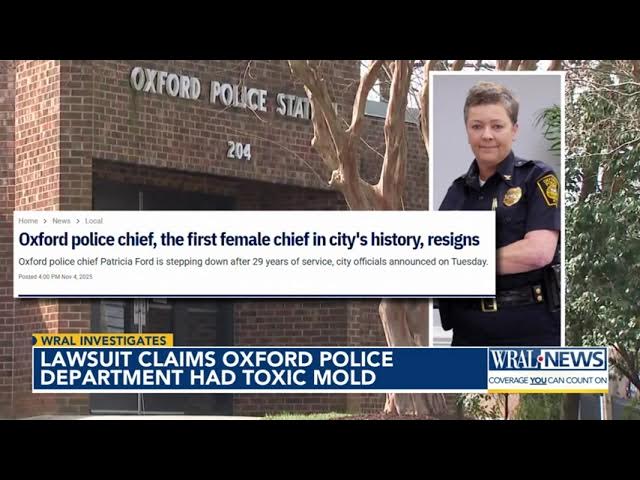
When you spend nearly 30 years protecting your community, the last thing you expect is for your workplace to slowly poison you. That is exactly what Patricia Ford — Oxford, North Carolina’s first female police chief — and two other law enforcement veterans are alleging in a newly filed civil lawsuit against the city of Oxford.
The suit, filed in February 2026 in Granville County, claims that city officials knew about dangerous toxic mold inside the Oxford Police Department for roughly 20 years and did nothing meaningful to fix it.
Worse, plaintiffs allege they were repeatedly told the mold wasn’t a problem — or didn’t exist at all.
This case is a sobering reminder that toxic mold doesn’t just threaten homeowners. It can quietly devastate the people who serve inside government buildings every single day.
Patricia Ford retired from the Oxford Police Department in 2025 after almost three decades of service. She is the department’s first female captain and chief — a historic figure in her community.
Now, she and two other law enforcement officers are plaintiffs in a civil negligence lawsuit targeting the city of Oxford and five named individuals.
The officers reported a range of health symptoms they believe are connected to mold exposure at the police headquarters, located at the corner of Lanier and Monahan Streets in Oxford.
Symptoms included:
- Difficulty breathing
- Persistent coughing
- Tightness in the chest
- Headaches
These are the exact symptoms the U.S. EPA identifies as common health complaints among occupants of mold-contaminated buildings.
What makes this case particularly troubling is not just the presence of mold — it is the alleged response from city leadership.
According to court documents, officers “repeatedly reported” health concerns to city officials over recent years. Rather than investigating or fixing the problem, city officials allegedly told plaintiffs the suspected mold growth was simply “dirt that could be wiped off”.
The lawsuit claims the defendants “repeatedly assured Plaintiffs and others that no mold issue existed or the issues relating to mold had been completely fixed” — even as workers continued to get sick.
The attorneys representing the plaintiffs noted that as of publication, the lawsuit had not yet been formally served to the defendants, though it was filed in the public records system due to statute of limitations concerns tied to specific dates in the case.
Legal Rights of Mold-Exposed Workers
Workers who believe their health has been harmed by mold have legal options. Under OSHA’s General Duty Clause, employers are required to maintain a safe work environment and must take steps to address known mold hazards.
When employers ignore complaints, workers may be able to pursue civil negligence lawsuits — exactly what Ford and her co-plaintiffs are doing.
To succeed in a mold exposure claim, plaintiffs generally must demonstrate four elements:
- Duty of care — The employer had a legal responsibility to maintain a safe building
- Breach of duty — The employer allowed unsafe mold conditions to persist
- Causation — The mold exposure directly caused the health problems
- Damages — The workers suffered measurable harm
The Oxford case also parallels a 2011 lawsuit in Louisville, Kentucky, where 15 current and former police employees sued the city after allegedly being sickened by toxic mold in a city office building.
The CDC’s National Institute for Occupational Safety and Health (NIOSH) emphasizes that visible mold growth or a persistent moldy odor in any workplace should be treated as an active hazard requiring immediate investigation.
Why Government Buildings Are Often Vulnerable
Police stations, courthouses, and municipal offices are not immune to mold. In fact, many older government buildings carry increased risk because of:
- Aging infrastructure with outdated HVAC systems
- Delayed maintenance due to budget constraints
- Lack of regular indoor air quality testing
- Poor communication channels for reporting health complaints
A well-documented case described by researchers in the American Phytopathological Society journal involved a contaminated courthouse and office building where occupants developed fatigue, headaches, chest tightness, mucous membrane irritation, and pulmonary disease.
Interior surfaces were found to be heavily contaminated with Stachybotrys chartarum, Aspergillus versicolor, and Penicillium species.
This pattern — a building with known water damage issues, worker health complaints, and delayed institutional response — mirrors what is alleged in Oxford.
Conclusion
Patricia Ford served her community for nearly 30 years. She broke barriers as Oxford’s first female police chief.
And if the allegations in this lawsuit are true, she and her colleagues spent years breathing contaminated air while being told nothing was wrong.
This case is about more than one police department. It is about the duty that employers — including cities and governments — owe to the people who work for them.
Indoor mold is not just a homeowner’s problem. It is a workplace safety issue, a public health issue, and in this case, potentially a legal issue worth millions of dollars.
For anyone working in an older government building who is experiencing unexplained respiratory symptoms, headaches, or persistent fatigue, the message from this case is simple: report it, document it, and do not accept a dismissal.
Mold that is not addressed does not go away.
It grows.
References
-
WRAL Investigates. “Former Oxford Police Chief Among Three to Sue City, Former Staff Over Allegations of ‘Toxic Mold.'” February 2026. https://www.wral.com/news/investigates/oxford-nc-police-dept-toxic-mold-lawsuit-february-2026/
-
U.S. Environmental Protection Agency. “Mold Remediation in Schools and Commercial Buildings — Health Effects and Symptoms.” https://www.epa.gov/mold/mold-remediation-schools-and-commercial-buildings-guide-appendix-b
-
U.S. Environmental Protection Agency. “Can Mold Cause Health Problems?” https://www.epa.gov/mold/can-mold-cause-health-problems
-
Centers for Disease Control and Prevention (CDC/NIOSH). “Mold, Testing, and Remediation.” https://www.cdc.gov/niosh/mold/testing-remediation/index.html
-
Centers for Disease Control and Prevention. “Health Problems | Mold.” https://www.cdc.gov/niosh/mold/health-problems/index.html
-
Vesper S, et al. “Stachybotrys chartarum (atra) Contamination of the Indoor Environment.” Canadian Respiratory Journal. PMC. https://pmc.ncbi.nlm.nih.gov/articles/PMC2828207/
-
MMRBH Law Office. “How to Sue for Mold Exposure at Work.” https://www.mmrbhlawoffice.com/suing-for-mold-exposure-at-work-what-you-should-know/
-
American Phytopathological Society. “Stachybotrys chartarum: The Toxic Indoor Mold.” https://www.apsnet.org/edcenter/apsnetfeatures/Pages/Stachybotrys.aspx
-
Kentucky.com. “Employees Sue, Claim Exposure to Toxic Mold.” August 2011. https://www.kentucky.com/news/state/kentucky/article44123700.html
-
CDC/NIOSH. “Mold in the Workplace.” https://www.cdc.gov/niosh/mold/about/index.html

0 Comments