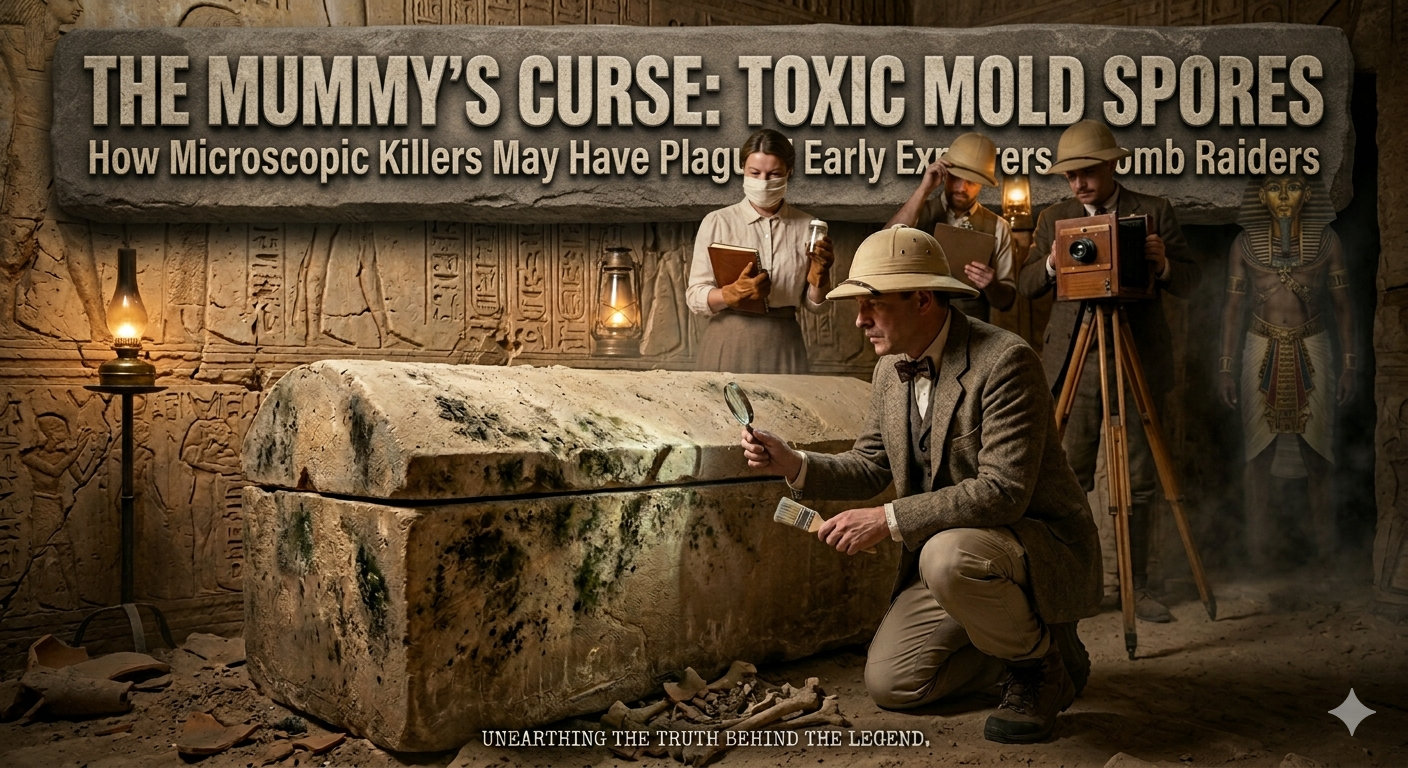
For nearly a century, the deaths that followed the opening of King Tutankhamun’s tomb were chalked up to supernatural revenge — an ancient pharaoh striking back from beyond the grave.
But science tells a different story.
The real curse may have been a toxic mold that had been quietly waiting in the dark for over 3,000 years.
Howard Carter had spent nearly fifteen years digging in Egypt’s Valley of the Kings without a major discovery.
By 1922, his financier, Lord Carnarvon, was considering pulling his funding.
Carter persuaded him to fund one final season. On November 4th, 1922, he found what he had been searching for: the nearly intact tomb of the boy pharaoh Tutankhamun.
The discovery captivated the world.
Royalty, dignitaries, scientists, and journalists crowded into the Valley of the Kings.
Then, in April 1923 — less than two months after the tomb’s inner chamber was opened — Lord Carnarvon was dead at age 56.
The Times of London reported on March 17, 1923, that he suffered from “pain as the inflammation affected the nasal passages and eyes”.
More deaths soon followed.
George Jay Gould, an American railway executive who had visited the tomb, died of a fever he contracted in Egypt.
Sir Archibald Douglas-Reid, the radiologist who X-rayed Tutankhamun’s mummy, died in January 1924.
Carter’s secretary, Richard Bethell, was found dead in his Mayfair club in 1929 — possibly smothered.
The headlines would not stop.
Howard Carter himself — the first person to enter the sealed chamber and breathe its ancient air — lived until 1939, dying at 64 of lymphoma cancer.
The deaths that lit the fuse of the “Mummy’s Curse” legend.
Modern researchers have identified a more grounded explanation for these mysterious deaths. Shuttered, isolated tombs can grow dangerous fungal molds, particularly Aspergillus flavus and its associated mycotoxin can cause illness, disease and death.
Including pneumonia and cancer.
According to UTMB Health, Lord Carnarvon reportedly suffered pain of the nasal passages and eyes before his death — both classic symptoms of an Aspergillus-caused sinus infection.
It is medically plausible that his fungal infection progressed to the fatal pneumonia that ultimately killed him.
A landmark 2015 study published in Carcinogenesis found that Aflatoxin B1 (AFB1), a carcinogen produced by Aspergillus flavus and Aspergillus parasiticus stimulates Epstein-Barr virus (EBV)-induced B-cell transformation – the mechanism behind Burkitt lymphoma, a fast-growing form of non-Hodgkin lymphoma.
The same cancer Howard Carter would die from
The study concluded that AFB1 acts as a “cofactor in EBV-mediated carcinogenesis,” essentially amplifying the virus’s cancer-causing power.
According to the University of Texas Medical Branch, shuttered and isolated tombs could grow dangerous fungal molds, particularly Aspergillus flavus, that could harm people with weakened immune systems.
The mummy of Ramses II was later found to harbor the same fungus, further connecting ancient Egyptian burial practices to Aspergillus contamination.
National Geographic further confirmed that “recent laboratory analyses have confirmed that some ancient mummies indeed harbor mold, including at least two hazardous species — Aspergillus niger and Aspergillus flavus.
As Joseph Wegner, an Egyptologist at the University of Pennsylvania Museum, explained to National Geographic:
“When we think about Egyptian tombs, we envision not just mummies but also provisions — meats, vegetables, and fruits placed there for the afterlife. These offerings could have attracted insects, molds, and bacteria. The organic materials were present thousands of years ago.”
Aspergillus flavus is a common mold found in soil, decaying vegetation, and stored grains. It is infamous for its ability to survive in harsh conditions, including the sealed compartments of ancient tombs, where it can remain dormant for thousands of years.
Some researchers, including Sir Arthur Conan Doyle, creator of Sherlock Holmes, famously suggested that Egyptian priests had deliberately planted fungal spores to punish grave robbers.
Or the science may be less dramatic, but no less remarkable: the tomb essentially booby-trapped itself through the natural accumulation of biological hazards over three thousand years.
In 1998, Dr. Sylvain Gandon, a researcher at the Laboratoire d’Écologie in Paris, demonstrated that fungal spores can lay dormant for hundreds of years while retaining their potency.
When a sealed tomb is opened after millennia, the rush of outside air disturbs the environment — and with it, clouds of dormant spores.
These particles, once inhaled, can cause a disease called aspergillosis. In milder cases, aspergillosis causes acute inflammation and breathing problems.
In severe cases, the fungus can grow inside the lungs and even spread throughout the body.
Lord Carnarvon’s reported symptoms — pain in the nasal passages, eye inflammation, and eventual pneumonia — are entirely consistent with invasive Aspergillus sinusitis with local extension to the orbit.
Howard Carter’s cancer can also be connected to mold and mycotoxin exposure.
This was not a curse. It was molds/fungi and their deadly toxins.
Ancient Egyptians prepared tombs with great care. They stored food offerings, oils, grain, linen, and organic materials inside burial chambers — creating ideal conditions for mold growth.
Aspergillus flavus grows readily on grain and decaying organic matter.
Once entombed and sealed, these organic materials provided a food source for mold to colonize over decades, centuries, and millennia.
The sealed environment also meant the mold spores had nowhere to go.
They accumulated in the still air, concentrated on surfaces, and waited.
According to the University of Texas Medical Branch, shuttered, isolated tombs create exactly the kind of closed, humid microenvironment where dangerous molds like Aspergillus flavus can thrive.
When the seal is finally broken and fresh air enters, the spores become airborne immediately.
Anyone standing nearby — especially the lead excavators who push through first — absorbs the full initial toxic mold exposure.
This explains why those closest to the opening of Tut’s tomb, and those who spent the most time in the burial chamber, were reportedly hit hardest.
The Polish King’s Tomb: A More Deadly Event
The most compelling evidence for mold as a killer came not from Egypt, but from Poland. In May 1973, a team of twelve scientists opened the sealed crypt of Casimir IV Jagiellon, a famous 15th-century Polish king.
The team was composed of conservationists, historians, and researchers — professionals doing serious scientific work.
Within weeks, ten of the twelve were dead.
Investigators were stunned. A microbiologist identified the presence of a deadly fungus, Aspergillus flavus, inside the tomb. The media compared the deaths to those that followed the opening of Tutankhamun’s tomb and called it the “Jagiellonian curse”.
But it wasn’t a curse.
It was the fungus/toxic mold.
Conclusion
The mummy’s curse was never supernatural. It was biological.
The deaths connected to the opening of King Tutankhamun’s tomb in 1922, and especially the deaths of ten Polish scientists in 1973 after opening the tomb of Casimir IV, point clearly to Aspergillus flavus as a deadly pathogen lurking in sealed ancient chambers.
These cases are not just fascinating historical footnotes.
They are powerful reminders that mold is a serious, life-threatening hazard — one that can survive for centuries in the right conditions and strike without warning when disturbed.
For homeowners, renters, and building professionals today, the message is the same as it would have been for those archaeologists in 1922: before you open a sealed, dark, damp space, stop and ask what might be growing inside.
Mold doesn’t need a curse to be deadly.
It just needs time, moisture, and the right opportunity.
References
-
ScienceDaily. “From Cursed Tomb Fungus to Cancer Cure: Aspergillus flavus Yields Potent New Drug.” June 23, 2025. https://www.sciencedaily.com/releases/2025/06/250623072748.htm
-
Penn Today, University of Pennsylvania. “Penn Engineers Turn Toxic Fungus into Anti-Cancer Drug.” June 24, 2025. https://penntoday.upenn.edu/news/penn-engineers-turn-toxic-fungus-anti-cancer-drug
-
WHYY / NPR Philadelphia. “Penn Engineers Turn Toxic Fungus into Cancer Fighting Tool.” July 5, 2025. https://whyy.org/articles/upenn-researchers-king-tuts-curse-fungus-cancer-treatment/
-
SciTechDaily. “Deadly Mold That Killed 10 Scientists Could Soon Save Thousands.” June 29, 2025. https://scitechdaily.com/deadly-mold-that-killed-10-scientists-could-soon-save-thousands/
-
BBC Science Focus. “The Deadly Fungus Behind Tutankhamun’s ‘Curse’ Could Now Save Lives.” July 31, 2025. https://www.sciencefocus.com/news/fungus-tutankhamuns-curse-cance
-
UTMB Health – Medical Discovery News. “Was It a Mummy’s Curse?” August 29, 2023. https://www.utmb.edu/mdnews/podcast/episode/was-it-a-mummys-curse
-
The Collector. “What Really Killed the Men Who Opened King Tut’s Tomb.” January 13, 2026. https://www.thecollector.com/mummy-curse-howard-carter/
-
Wikipedia. “Tomb of Casimir IV Jagiellon.” https://en.wikipedia.org/wiki/Tomb_of_Casimir_IV_Jagiellon
-
Ancient Origins. “The Cursed Tomb of Polish King Casimir IV Jagiellon.” https://www.ancient-origins.net/history-famous-people/cursed-tomb-polish-king-casimir-iv-jagiellon-005712
-
National Geographic. “Egypt’s ‘King Tut Curse’ Caused by Tomb Toxins?” May 6, 2005. https://www.nationalgeographic.com/science/article/news-tutankhamun-carnarvon-mold-bacteria-toxins
-
Business Insider. “Is the Curse of King Tut’s Tomb Caused by Fungi?” August 8, 2023. https://www.businessinsider.com/curse-tutankhamun-king-tut-pharoah-mummy-tomb-cause-fungi-2023-8
-
The Lancet. “Lord Carnarvon’s Death: The Curse of Aspergillosis?” September 5, 2003. https://www.thelancet.com/journals/lancet/article/PIIS0140-6736(03)14268-7/fulltext
-
Karmanos Cancer Institute. “A Deadly Fungus Killed 10 Scientists Working in a Tomb. It Could Be a Breakthrough in Curing Cancer.” https://www.karmanos.org/karmanos-foundation/news/in-the-news-a-deadly-fungus-killed-10-scientists-w-5815
-
The Conversation. “Toxic Fungus from King Tutankhamun’s Tomb Yields Cancer-Fighting Compounds.” July 1, 2025. https://theconversation.com/toxic-fungus-from-king-tutankhamuns-tomb-yields-cancer-fighting-compounds-new-study-259706
-
U.S. Environmental Protection Agency. Indoor Air Quality — Mold Resources. https://www.epa.gov/mold
-
Centers for Disease Control and Prevention / NIOSH. Mold in the Workplace. https://www.cdc.gov/niosh/topics/indoorenv/mold.html

0 Comments