
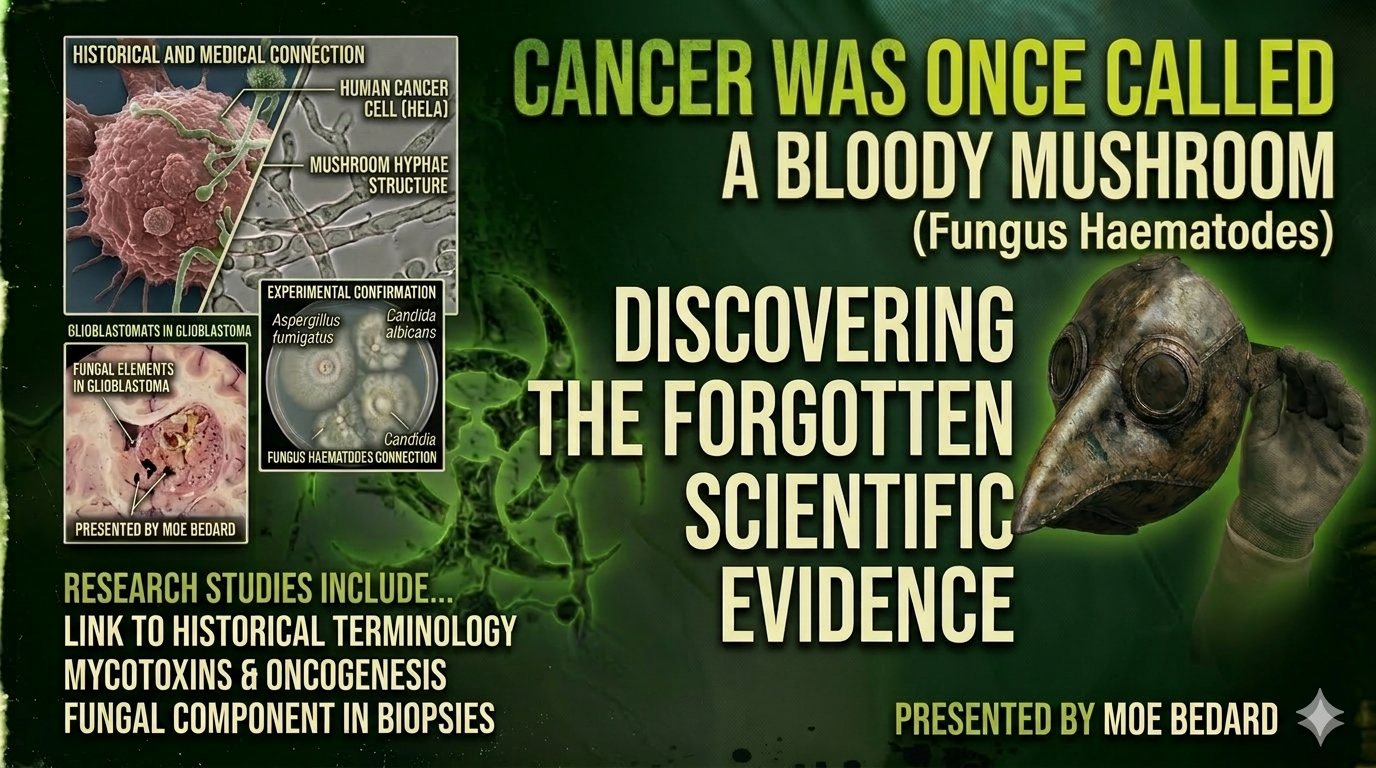
Long before mold was understood as a health threat, physicians and surgeons were already wrestling with the terrifying image of fungus-like growth inside the human body.
In the late 18th and early 19th centuries, some of the most dangerous and mysterious tumors a doctor could encounter were grouped under a single Latin name: Fungus hæmatodes — the “Bloody Mushroom.”
The term was surgical shorthand for a specific clinical reality.
These tumors did not look like cancer.
They looked like something growing.
Something alive.
Something fungal.
The mass grew fast, fed on blood, and spread with the same unstoppable drive of a fungus pushing through rotting wood.
For more than a hundred years, that name stuck.
Then modern science came along, reclassified everything into tidy Latin categories, and quietly retired the word fungus from the cancer vocabulary.
Here is what they did not tell you: the men who named those tumors after mushrooms may have been more right than anyone wanted to admit.
Today, peer-reviewed research is confirming what 19th-century surgeons described by eye — that fungi are not just a metaphor for cancer.
They are being found inside cancer cells, hiding in tumor tissue, driving immune suppression, and actively shaping how cancers grow, spread, and resist treatment.
The names were changed. The biology stayed the same.
In the Encyclopedia of Practical Medicine released in 1833 by Sir Jon Forbes stated that cancer was a fungus. In fact they named it by the Latin name, Fungus Haematodes, which means Bloody Mushroom.
The description reads:
“We characterize it then morbid condition of the body, evinced by the development of an elastic uneven tumour, or tumours, not painful in their early stage, and becoming so only by implication with surrounding parts; tending to ulceration, and by ulceration presenting to view a soft and spongy fungus, rapid in its growth, readily bleeding in vascular textures, and emitting a peculiar serous discharge of a very fetid odour, more or less coloured with blood.”
The term was more than just poetic. It captured something visceral and real: a tumor that grew rapidly, bled profusely, and spread through tissue with the same relentless efficiency that a mushroom cap expands through damp wood.
To physicians of the era, the resemblance was unmistakable and deeply unsettling.
The word “fungus” was not used carelessly.
These were not guessing men. They were describing what was in front of them with the tools they had. And what they saw, again and again, was a tumor that behaved like a fungus.
It was a deliberate choice to invoke something biological, organic, and invasive — something that grew from within, rather than being caused by injury or external force.
In this way, early surgeons were actually closer to modern thinking than they realized: they understood that cancer was a problem of unchecked biological growth, not simply a wound or an infection.
The use of hæmatodes (bloody) was equally precise. These tumors were notorious for hemorrhage. When surgeons attempted to remove them, bleeding could be catastrophic.
The vascularity of the tumor — its rich network of abnormal blood vessels — is what made it both distinctive and deadly.
The formal coining of the term fungus hæmatodes is generally attributed to William Hey (1736–1819), a surgeon at Leeds, England. Hey was a meticulous clinician and surgical innovator who made many contributions to 18th-century medicine, including improved techniques for hernia repair, cataract surgery, and the treatment of dislocations.
According to a landmark historical review published in Cancer (Hajdu, 2007), “In 1803, Hey (1736–1819), who was a surgeon at Leeds, England, introduced the term ‘fungus haematodes’ for highly vascular, fungating tumors of the limbs.”
Other sources, including the Dictionary of National Biography, credit Hey as the first to “fully describe and name the growth called ‘fungus hæmatodes.'”
Hey published his observations in a treatise that documented cases of these grotesque and often fatal tumors. The name itself was carefully chosen.
Fungus referred to the mushroom-like, raised, and spongy appearance of the mass.
Hæmatodes comes from the Greek haima (blood), meaning “of blood” or “bloody.”
Together, the term described a soft, bloody tumor that grew outward and upward, like a fungus pushing through soil.
William Hey was no fringe figure. He was a fellow of the Royal Society, a founding figure of the Leeds Infirmary, and one of the most respected surgeons in northern England during his era.
His recognition and naming of fungus hæmatodes was taken seriously by the medical establishment, and the term quickly entered standard surgical vocabulary.
His colleagues understood immediately. The mass grew fast, fed on blood, and spread with the same unstoppable drive of a fungus pushing through rotting wood.
For more than a hundred years, that name stuck.
Then come other scientists came along, reclassified everything into tidy Latin categories, and quietly retired the word fungus from the cancer vocabulary.
Let me explain…
Six years after William Hey published his study on fungus haematodes, in 1809, the Scottish surgeon James Wardrop published his Observations on Fungus Hæmatodes or Soft Cancer, documenting 17 cases across multiple organs — the eye, the limbs, the breast — and arguing that this type of tumor was its own distinct entity.
As if each one was a separate disease and should be dealt with separately.
Wardrop was 23 years old. His work eventually led to the first clinical description of retinoblastoma, the pediatric eye cancer that would not receive its modern name until 1926 — over 100 years later.
By the mid-1800s, Rudolf Virchow and the emerging science of histopathology began breaking fungus hæmatodes into a million pieces at the cellular level.
By doing this, they were focusing mainly on the symptoms and various pathologies at the cell level that the fungi caused within the human body rather than the root cause of the disease.
The basket category was sorted into retinoblastoma, uveal melanoma, angiosarcoma, soft tissue sarcoma, and medullary carcinoma.
Each got its own name.
Each got its own research track.
Physicians who used to be more holistic and treat the whole body and mind were now being trained to work in silos at the cellular level and to specialize in specific cancers.
The Reclassification of Fungus to Cancer That Buried the Clue
By the mid-1800s, Rudolf Virchow and the emerging science of histopathology began breaking fungus hæmatodes apart at the cellular level. The basket category was sorted into retinoblastoma, uveal melanoma, angiosarcoma, soft tissue sarcoma, and medullary carcinoma. Each got its own name. Each got its own research track.
The word fungus was stripped out entirely.
That reclassification was said to be scientifically necessary because they said you cannot develop targeted therapies when you are grouping a dozen different cancers under a single visual description.
The shift from appearance-based diagnosis of what was clearly a fungal growth on various organs and parts of the body to cellular and molecular classification was one of the greatest travesties of modern medicine.
Soon fungus was eventually erased from the medical records and modern treatments.
The term “soft cancer” used by Wardrop distinguished these tumors from harder, scirrhous cancers (what we would now recognize as fibrotic carcinomas). In the early 19th century, this was a meaningful clinical distinction — soft tumors were considered more immediately dangerous because they grew faster, bled more heavily, and were more likely to spread.
Under the umbrella of fungus hæmatodes, early surgeons likely included:
Retinoblastoma — a childhood eye cancer now known to involve a genetic mutation in the RB1 tumor-suppressor gene
Uveal melanoma — a rare but aggressive cancer of the inner eye
Soft tissue sarcomas — a broad category of cancers arising from connective tissue, muscle, and fat
Vascular sarcomas — including what modern medicine now calls angiosarcoma, characterized by rapidly proliferating blood vessel tissue
Medullary carcinomas — soft, rapidly growing cancers that had a fungating, bloody appearance
The Doctor Who Closed the Door on Fungus and Cancer — and Why That Decision Haunted Medicine for 100 Years
In 1870, a Viennese ophthalmologist named Karl Stellwag von Carion (1823–1904) published one of the most influential medical textbooks of his era. His Lehrbuch der praktischen Augenheilkunde — later translated into English as Treatise on the Diseases of the Eye — was a landmark work.
It was thorough, precise, and widely respected. It was also, in one critical area, almost certainly wrong.
And doctors followed that wrong turn for the next hundred years.
Stellwag was working in the tradition of Rudolf Virchow, the father of cellular pathology. He examined soft ocular tumors — previously called Fungus hæmatodes — under a microscope and described what he saw in careful detail: “small round cells with large round nuclei which were quite close to the cell wall,” along with “fibrosis and fatty degeneration at the extension of the tumor.” This was serious, disciplined science for its time.
But then Stellwag went further. He didn’t just describe what the tumor looked like.
He made a defacto ruling for all humanity that we still live under today.
He deliberately refused the idea that fungus was the cause of these cancers — a theory that had been seriously entertained by physicians well into the early 20th century. In one authoritative stroke, he dismissed it. No fungus. Case closed.
The problem is that Stellwag made this call without the tools to actually prove it.
Mycology — the science of fungi — was still in its infancy in 1870. The relationship between fungal organisms, mycotoxins, and human tissue was barely understood. Germ theory itself had only recently been accepted.
Stellwag was applying the best histological tools of his day, but those tools could not detect fungal metabolites, could not identify mycotoxin damage at the cellular level, and could not distinguish between a tumor caused by fungal activity and a tumor that simply no longer showed visible fungal structures by the time it was examined.
He saw round cells and nuclei. He did not see a mushroom cap. So he ruled fungi out entirely.
What followed was a century of medical orthodoxy built on that single stated decision.
Oncologists trained under the assumption that Stellwag had settled the question. The fungal hypothesis was not disproven through accumulated research — it was administratively closed by one respected physician in one respected book. Generations of cancer researchers moved forward inside that boundary without looking back.
This matters enormously.
Because we now know that certain fungi — including Aspergillus, Candida, and others — produce mycotoxins capable of directly damaging DNA.
We know that fungal infections can drive chronic inflammation, and that chronic inflammation is one of the most well-established drivers of cancer development. Research published in the 21st century has found fungal DNA inside human tumor tissue.
The question Stellwag dismissed in 1870 has quietly come back to life in modern oncology labs.
Stellwag’s statement — that he “refused the idea that a fungus was the cause” — is a remarkably honest record of a deliberate choice.
He wasn’t simply assuming fungi were irrelevant.
He was consciously overruling a competing theory. That distinction matters.
It means the fungal hypothesis was never truly defeated by evidence.
It was voted down by authority.
And for roughly a hundred years, no one thought to call for a revote.
Research published in the journal Cancer (Hajdu, 2007) traces this evolution: the same tumors that 18th-century surgeons called fungus hæmatodes are now classified using histopathology, immunohistochemical markers, and genetic profiling.
In its place there have been well over 1,000 distinct cancer names and the names are still growing further burying the fungi/molds connection that has been established for over 200 years until now.
The shift from visual classification to cellular classification was made possible by Rudolf Virchow (1821–1902), who proposed a histopathologic classification of vascular tumors in the mid-19th century. Virchow’s work broke down the category of fungus hæmatodes into its component parts — each with its own origin, behavior, and prognosis.
A 2021 PMC review notes, “Around the mid-19th century, Virchow proposed a histopathologic classification based on the size and appearance of the vessels.”
When the fungal metaphor was retired, so was the question it implied: Is there actually a biological relationship between fungi and these cancers?
For most of the 20th century, nobody seriously asked. The idea seemed primitive — almost embarrassing, a relic of pre-scientific medicine.
Microbial roles in cancer have been, as researchers at Science wrote in 2021, “disputed for centuries.”
Yet for most of the 20th century, the dominant model in oncology held that tumors were essentially sterile environments — sealed chambers of mutating cells, untouched by the microbial world surrounding them.
That model is now crumbling.
How Fungi Drive Tumor Progression
This is not just passive coexistence. The research is showing that fungi inside tumors are active players — changing the biology of the cancer itself.
A 2022 study published in Cancer Cell found that the intratumoral fungal mycobiome drives the secretion of IL-33, an immune-suppressing protein in pancreatic cancer. In plain language: fungi inside pancreatic tumors were helping the cancer hide from the immune system. The study showed that “anti-fungal treatment decreases T~H~2 and ILC2 infiltration and increases survival.”
Treating the fungi improved cancer survival outcomes.
A separate 2021 study, also published in Cancer Cell, found that intestinal fungi regulate antitumor immune responses following radiation therapy — and that fungi and bacteria actually have opposite influences on cancer treatment effectiveness. Elevated intratumoral expression of Dectin-1, the body’s primary immune sensor for fungi, was negatively associated with survival in breast cancer patients.
Research published in 2023 in PMC identified the fungus Aspergillus sydowii enriched inside lung adenocarcinoma tumors. This fungus was found to promote tumor progression through a chain of immune suppression: it triggered IL-1β secretion, which recruited myeloid-derived suppressor cells, which in turn suppressed the cancer-fighting T cells and allowed the tumor to grow unchecked.
A 2025 review in PMC went further, finding that “fungal metabolites influence microbial communities, regulate immune cell activity, and alter tumor cell metabolism, collectively contributing to immune evasion, proliferation, metastasis, and therapeutic resistance.”
This is not metaphor.
This is mechanism.
As a 2024 review published in Signal Transduction and Targeted Therapy noted, tumor tissues “once considered sterile actually host a variety of microorganisms, which have been confirmed to be closely related to oncogenesis.”
The Pan-Cancer Mycobiome: Fungi Are Everywhere in Cancer
The modern revolution in understanding the relationship between fungi and cancer began accelerating in earnest around 2021–2022, culminating in two extraordinary papers published simultaneously in Cell in September 2022.
The Weizmann Institute Pan-Cancer Study
The first, led by researchers at the Weizmann Institute of Science in Israel, analyzed 17,401 patient tissue, blood, and plasma samples across 35 cancer types in four independent patient cohorts. Their findings were unambiguous: fungal DNA and fungal cells were present at low but detectable abundances across many major human cancers, with distinct fungal community compositions that differed between cancer types.
Crucially, this wasn’t just contamination or environmental background noise.
Histological staining of tissue microarrays confirmed the intratumoral presence of fungi — physically inside tumor tissue — and showed frequent spatial association between fungal organisms and both cancer cells and macrophages.
The study also found clinically meaningful correlations. Breast cancer patients who had the fungus Malassezia globosa present in their tumors had significantly lower survival rates than those who did not.
Specific fungi were found more frequently in lung tumors of smokers than non-smokers, and in melanoma tumors that failed to respond to immunotherapy compared to those that responded.
“This study sheds new light on the complex biological environment within tumours,” said Prof. Ravid Straussman of the Weizmann Institute’s Molecular Cell Biology Department. He and his co-authors described fungal activity as “a new and emerging hallmark of cancer.”
A 2023 review published in PMC titled “The fungal mycobiome: a new hallmark of cancer” confirmed that fungi are present across cancer types with a specificity that cannot be explained by random contamination.
Cladosporium sphaerospermum and the Cladosporium genus were found enriched in breast tumors
Aspergillus and Agaricomycetes were elevated in lung cancer
Blastomyces was identified in lung cancer
Malassezia globosa was found in breast cancer with direct correlation to reduced survival
Aspergillus sydowii was enriched inside lung adenocarcinoma tumors and found to actively suppress immune function
Candida species were identified in gastrointestinal cancers
Aspergillus and Fusarium occupied critical positions in renal cell carcinoma mycobiomes, with higher fungal diversity correlating with poorer prognosis
A 2025 review in Nature confirmed: “Metagenomic analysis revealed fungal DNA in tumors and suggested their role in inflammation-driven carcinogenesis.”
The research published between 2022 and 2025 strongly suggests the answer, in many cases, is both — and that the distinction may matter less than previously thought.
Rewiring the Immune System
One of the most consistent findings across multiple studies is that intratumoral fungi manipulate the immune environment in ways that favor tumor growth and hinder the body’s ability to fight back.
Candida albicans, for example, has been shown to promote tumor-associated macrophage infiltration and shift those macrophages toward a “M2” polarization state — a pro-tumor, anti-inflammatory configuration that actively suppresses the immune system’s ability to attack cancer cells.
In oral cancers, C. albicans infection reduced the presence of CD8+ T-cells (key cancer-killing immune cells) while increasing inflammatory signaling through the IL-17A pathway. A 2025 study published in eLife found that C. albicans drives colorectal cancer progression by activating MAPK and NF-κB signaling pathways — promoting tumor cell migration — through secretion of a toxin called candidalysin.
As a 2024 review in Frontiers in Cellular and Infection Microbiology summarized, fungi can induce the accumulation of regulatory T-cells (Tregs), which “suppress antitumor immunity” by secreting immunosuppressive cytokines including IL-10 and TGF-β, “enabling tumor cells to escape immune surveillance.”
Malassezia and Breast Cancer: A Case Study in Fungal Carcinogenesis
Perhaps the most striking recent case involves Malassezia globosa — a lipophilic yeast naturally found on human skin — and its role in breast cancer.
Multiple independent studies have now confirmed that Malassezia globosa is abundant in breast tumor tissue and is associated with significantly shortened overall survival in breast cancer patients.
A 2024 study demonstrated that the fungus colonizes mammary tissue in animal models, increases tumor incidence, and accelerates tumor growth through a mechanism involving the IL-17A/macrophage axis and activation of sphingosine kinase 1 (Sphk1).
A 2025 study published in MicrobiologyOpen extended these findings, showing that M. globosa activates a pro-inflammatory signaling cascade (MBL-C3a-C3aR) to trigger M2 macrophage polarization — directly promoting breast cancer progression.
Critically, the study found that treatment with the antifungal drug amphotericin B impeded tumor growth in patient-derived breast cancer models.
This is not a trivial finding. It means that a common skin fungus can enter breast tissue, activate inflammatory and immune-suppressive pathways, and accelerate one of the most common cancers in women — and that an antifungal drug can slow that process down.
The American Association for Cancer Research (AACR) acknowledged the paradigm shift directly: “Researchers have discovered that tumors and their surrounding milieu also house various fungal species — comprising what is known as the mycobiome — and that the presence of these fungi appears to influence the development and progression of cancer.”
The Mycotoxin Connection: Mold’s Chemical Weapon
Beyond the fungi living inside tumors, there is the question of what fungi/molds produce — and the answer is deeply relevant to anyone who has ever lived in a water-damaged building.
Mycotoxins are the toxic chemical compounds secreted by mold species like Stachybotrys chartarum, Aspergillus, and others.
Research has documented their capacity to directly damage cellular DNA, suppress immune function, disrupt hormone signaling, and trigger the kind of chronic inflammation that creates conditions favorable to cancer development.
A 2017 review published in Spandidos Publications identified specific mycotoxins as carcinogenic or cancer-promoting: Aflatoxin B1, Citrinin, Fumonisins, Patulin, Trichothecene, and Zearalenone.
Aflatoxin B1 alone — produced by Aspergillus mold species — is classified by the International Agency for Research on Cancer (IARC) as a Group 1 carcinogen, meaning it is definitively known to cause cancer in humans.
Research on Stachybotrys chartarum published in Toxicological Sciences documents that macrocyclic trichothecene mycotoxins — the signature toxins of black mold — “are 10–100 times more potent than Type A or Type B trichothecenes at activating MAPKs, impairing leukocyte proliferation, or inducing apoptosis.”
Chronic low-level exposure to these compounds in a water-damaged home does not cause immediate dramatic illness. It creates a slow-burn environment of cellular dysfunction, immune suppression, and inflammatory damage — the exact conditions under which cancers take root and grow.
In 2025, the American College of Medical Toxicology issued a new position statement acknowledging research links between mycotoxin exposure and DNA damage, immune dysfunction, and cancer-promoting biological cascades
This is the scientific establishment catching up to what William Hey observed at a surgical table in Leeds more than 200 years ago.
Conclusion: The Bloody Mushroom Was a Warning
When William Hey named Fungus hæmatodes the Bloody Mushroom, he was doing what every great clinician does — observing closely, naming honestly, and refusing to look away from something that made him uncomfortable. The tumor grew like a fungus.
He called it a fungus.
Science eventually told him he was using the wrong vocabulary.
But science is now circling back.
The fungi inside tumors are real.
The mycotoxins that damage DNA are real.
The immune-suppressing mechanisms by which intratumoral fungi help cancers escape treatment are real and documented in journals like Cell, Cancer Cell, and Nature.
The pan-cancer mycobiome is being described, right now, as “a new hallmark of cancer.”
The names were changed. The biology was never wrong.
What Hey and Wardrop lacked was not observational skill. It was a metagenomics sequencer and two hundred years of cellular biology.
They saw a bloody, fungal-looking tumor and named it honestly. We now know that inside those tumors — in all likelihood — actual fungi were present, suppressing the immune system, secreting metabolites, and helping the cancer grow.
The Bloody Mushroom was not just a metaphor. It was a clinical observation waiting for science to catch up.
For people who have lived in mold-contaminated buildings — especially structures with Stachybotrys, Aspergillus, or Penicillium contamination — the implications of this emerging science are serious and deserve direct discussion.
The molds on your walls are not separate from the biology of cancer.
They share a kingdom, a mechanism, similar biology and — increasingly — a body of research that demands to be taken seriously.
The fungal hypothesis that Stellwag dismissed in 1870 was never disproven. It was simply buried and postponed until now.
And after 150 years, the bill for that postponement is coming due — both in the research labs trying to catch up, and in the bodies of people who were told that the mold in their walls had nothing to do with their illness.
Awareness is not enough.
But it is where everything starts.
For homeowners and patients who have experienced mold exposure, this represents a profound development: the fungi you were told had nothing to do with cancer may, in fact, leave detectable signatures in your bloodstream and in your tissue that could one day guide diagnosis, treatment, and possibly a cure.
References
- Wardrop, James (1809). Observations on Fungus Hæmatodes or Soft Cancer. https://archive.org/details/observationsonfu00ward
- Sir John Forbes, Alexander Tweedie, John Conolly · 1833 – The Cyclopædia of Practical Medicine
-
Alam, A., et al. (2022). “Fungal mycobiome drives IL-33 secretion and type 2 immunity in pancreatic cancer.” Cancer Cell. https://pubmed.ncbi.nlm.nih.gov/35120601/
-
Shiao, S.L., et al. (2021). “Commensal bacteria and fungi differentially regulate tumor responses to radiation therapy.” Cancer Cell. https://pubmed.ncbi.nlm.nih.gov/34329585/
-
Weizmann Institute / ecancer (2022). “Human tumors are prized real estate for fungi, study finds.” https://ecancer.org/en/news/22279
-
PMC/NIH (2023). “The fungal mycobiome: a new hallmark of cancer revealed by pan-cancer analysis.” https://pmc.ncbi.nlm.nih.gov/articles/PMC9892023/
-
PMC/NIH (2023). “How the intratumor mycobiome modulates lung adenocarcinoma.” https://pmc.ncbi.nlm.nih.gov/articles/PMC10901296/
-
PMC/NIH (2025). “Fungi and cancer: unveiling the complex role of fungal infections in tumour biology.” https://pmc.ncbi.nlm.nih.gov/articles/PMC12185418/
-
Nature (2025). “Intratumor fungi specific mechanisms to influence cell death.” https://www.nature.com/articles/s41420-025-02483-z
-
Hajdu, S.I. (2007). “Soft tissue sarcomas.” Cancer. https://acsjournals.onlinelibrary.wiley.com/doi/full/10.1002/cncr.22608
-
Andersen, B., et al. (2008). “Stachybotrys chartarum, Trichothecene Mycotoxins, and Damp Building-Related Illness.” Toxicological Sciences. https://academic.oup.com/toxsci/article/104/1/4/1717327
-
Spandidos Publications (2017). “Effects of different mycotoxins on humans, cell genome and their involvement in cancer.” https://www.spandidos-publications.com/10.3892/or.2017.5424
-
AACR (2022). “The Fungus Within Us: The Mycobiome’s Emerging Role in Cancer.” https://www.aacr.org/blog/2022/12/08/the-fungi-within-us-the-mycobiomes-emerging-role-in-cancer/
-
Dohlman, A.B., et al. “A pan-cancer mycobiome analysis reveals fungal involvement in gastrointestinal and lung cancers.” Cell, 2022. https://pubmed.ncbi.nlm.nih.gov/36179671/
-
Narunsky-Haziza, L., et al. “Pan-cancer analyses reveal cancer-type-specific fungal ecologies and bacteriome interactions.” Cell, 2022. https://pubmed.ncbi.nlm.nih.gov/36179670/
-
Zhang, H., et al. “The intratumoral microbiome’s influence on tumorigenesis, cancer progression, and therapy.” Molecular Cancer, 2024. https://pubmed.ncbi.nlm.nih.gov/39087354/
-
Breast Cancer Colonization by Malassezia globosa accelerates tumor progression. mBio, 2024. https://pubmed.ncbi.nlm.nih.gov/39235230/
-
Fungal Colonization by Malassezia globosa promotes breast cancer progression. MicrobiologyOpen, 2025. https://pubmed.ncbi.nlm.nih.gov/41381403/
-
Claeys, L., et al. “Mycotoxin exposure and human cancer risk: a systematic review.” Critical Reviews in Food Science and Nutrition, 2020. https://pubmed.ncbi.nlm.nih.gov/33337079/
-
Groopman, J.D., et al. “Aflatoxin and the etiology of liver cancer.” PMC, 2021. https://pmc.ncbi.nlm.nih.gov/articles/PMC8797158/
-
DNA Damage and Responses in THP-1 Monocytes exposed to Stachybotrys chartarum. PMC, 2010. https://pmc.ncbi.nlm.nih.gov/articles/PMC2902923/
-
Wang, X., et al. “Candida albicans promotes oral cancer via IL-17A.” PubMed, 2023. https://pubmed.ncbi.nlm.nih.gov/37067414/
-
Candida albicans drives colorectal cancer progression. eLife, 2025. https://elifesciences.org/reviewed-preprints/108665
-
Sepich-Poore, G.D., et al. “The microbiome and human cancer.” Science, 2021. https://pubmed.ncbi.nlm.nih.gov/33766858/
-
Mycotoxins in Food: Cancer Risks and Strategies for Control. PMC, 2024. https://pmc.ncbi.nlm.nih.gov/articles/PMC11545588/
-
World Health Organization. “Mycotoxins — Fact Sheet.” October 2023. https://www.who.int/news-room/fact-sheets/detail/mycotoxins
-
AACR Blog. “The Fungi Within Us: The Mycobiome’s Emerging Role in Cancer.” December 2022. https://www.aacr.org/blog/2022/12/08/the-fungi-within-us-the-mycobiomes-emerging-role-in-cancer/
-
Update on the role of mycobiome in gastrointestinal cancers. PubMed, 2025. https://pubmed.ncbi.nlm.nih.gov/41452539/

0 Comments