
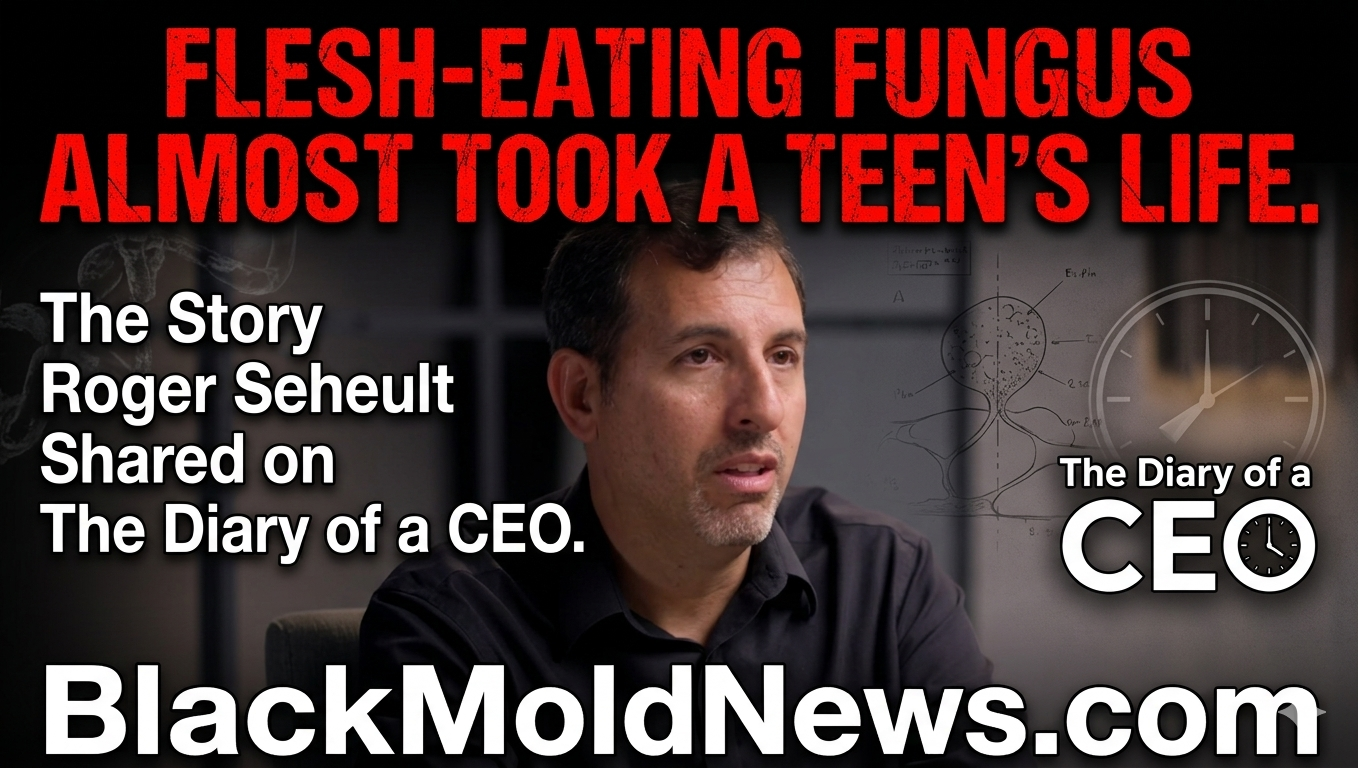
In a July 2025 episode of The Diary of a CEO podcast hosted by entrepreneur Steven Bartlett, Dr. Roger Seheult — a board-certified pulmonologist and critical care physician — described one of those cases.
He told the story of a 15-year-old boy who had been battling blood cancer, only to have a flesh-eating fungal infection consume his lung tissue and push him to the very edge of death.
This wasn’t a fictional medical drama.
This was a real boy — a real family — sitting in a real hospital room in Minnesota in the summer of 2024, being told he had roughly two days to live.
According to Dr. Seheult, the story began with a mother named Amy Honmeyer and her teenage son.
He was diagnosed with lymphoblastic leukemia — a blood cancer that originates in the bone marrow and disrupts the body’s production of white blood cells.
Treatment for lymphoblastic leukemia almost always involves aggressive chemotherapy. That chemotherapy works by attacking rapidly dividing cancer cells, but it also attacks healthy immune cells in the process.
The side effect is a severely suppressed immune system — a condition called neutropenia — that leaves the patient dangerously vulnerable to infections that a healthy person’s body would easily fight off.
That window of vulnerability is when the fungus struck.
According to Dr. Seheult, the boy developed a fungal flesh-eating infection in his lung — a condition consistent with what medicine calls invasive pulmonary mucormycosis.
The boy was admitted to a tertiary care hospital in Minnesota in June of 2024. The medical team threw everything at the fungal infection.
Dr. Seheult described the medications used on the DOAC podcast:
Amphotericin B — a powerful, often described as brutal antifungal medication known for serious side effects including kidney toxicity
Posaconazole — an azole antifungal drug commonly used for invasive mold infections in immunocompromised patients
“All of these things are really high-powered drugs that just completely fight fungus,” Dr. Seheult said during the episode. “But it’s not working. He’s getting worse.”
When medications failed to stop the spread, the medical team took an extraordinary surgical step: they removed the boy’s left lung entirely.
This is called a pneumonectomy, and it is a radical, life-altering procedure even in a healthy adult — let alone a 15-year-old already weakened by leukemia and chemotherapy.
After the surgery, there was briefly hope. Then a CT scan delivered devastating news. The fungal infection had migrated to the remaining right lung.
What Dr. Seheult described next in the podcast was one of the hardest conversations that can happen in a hospital.
Doctors called a family conference. They told the family that they had done everything medically possible. They could not remove the right lung.
They could not put the boy on a heart-lung machine because there was no realistic destination — no path forward that surgery could offer.
They recommended transitioning the boy to Do Not Resuscitate (DNR) status.
“He’s 15, he’s completely awake, he’s completely alert, he knows everything that’s going on around him,” Dr. Seheult recalled Amy Honmeyer telling him. He was on a BiPAP machine — a device that assists breathing without full intubation — but he was aware of every word.
Doctors estimated he had approximately two days to live.
The Dying Wish
When the boy was told he was dying, his family asked him what he wanted to do with whatever time remained. Surrounded by machines, IV lines, and sterile hospital walls — after six weeks of confinement without ever seeing the outdoors — his answer was simple.
He wanted to go outside.
“This guy grew up probably on a farm or something and he spent his time outside,” Dr. Seheult reflected on the podcast.
What happened next, as described by Dr. Seheult, was a testament to the kind of compassion that still exists in medicine. Nurses and respiratory therapists moved heaven and earth to honor that wish.
They wheeled his hospital bed outside, BiPAP machine attached and running.
They were not doing it to heal him.
They were doing it because a dying boy asked for sunlight.
He survived the first day.
Then something unexpected happened. His white blood cell count — a key marker of how aggressively the body is fighting infection — began to drop.
That was a good sign. By the second day, it dropped further. His oxygen requirement began decreasing. By day five — three days past the point when he was supposed to die — he was off the BiPAP entirely and breathing through a simple nasal cannula.
Doctors ordered a new CT scan of the right lung. According to Dr. Seheult’s account on the podcast, some in the room swore out loud when they saw the results. The infection in the remaining right lung had resolved 60 to 70 percent.
He went home. There was no sign of active fungal disease.
“She just can’t believe that he was literally two days away from dying,” Dr. Seheult said. Amy Honmeyer communicated with him after the boy returned home to update him — the boy had received his Make-A-Wish request for his cancer and was continuing treatment.
The Science Behind the Recovery
Dr. Seheult is careful not to present this as a miracle with no explanation. He offered a scientific hypothesis rooted in the emerging field of photobiomodulation — the study of how light interacts with biological tissue.
His theory centers on infrared light from the sun and its potential ability to penetrate tissue and stimulate mitochondria — the energy-producing organelles in every human cell.
He references a 2019 paper by researcher Russell Ryder of the University of Texas and light engineer Scott Zimmerman, which proposed that infrared radiation from sunlight can penetrate up to approximately 8 centimeters into the body and stimulate mitochondrial function.
Additionally, the medical team was using a light therapy device called a Firefly — a device that emits specific wavelengths of light — three times per day for approximately five minutes each session.
Dr. Seheult acknowledged on the podcast that he is not certain whether it was the natural sunlight, the Firefly device, or a combination of both that triggered the recovery.
What he does emphasize is what did not change: the antifungal medications remained the same, the dosing remained the same, and there were no new interventions added.
The only variable was sustained exposure to natural outdoor light after six weeks of complete indoor confinement.
Conclusion
A 15-year-old boy in Minnesota sat outside in a hospital bed with one lung and two days to live.
His body was fighting a flesh-eating fungal infection that the most powerful antifungal drugs in modern medicine could not stop. His one request was simple: to go outside.
Whether it was the sunlight, the Firefly device, or some combination of environmental factors, the outcome defied medical prediction.
Dr. Roger Seheult shared this story on one of the world’s most listened-to podcasts as a reminder that human biology is far more complex — and far more responsive to its environment — than the walls of a modern hospital often allow.
References
-
Singjupost.com — Full transcript, Dr. Roger Seheult on The Diary of a CEO with Steven Bartlett, July 16, 2025: https://singjupost.com/vitamin-d-expert-dr-roger-seheult-on-the-diary-of-a-ceo-podcast-transcript/
-
Instagram reel — Dr. Roger Seheult story summary, The Diary of a CEO: https://www.instagram.com/reel/DMgr1bPyi5x/
-
YouTube — “A Boy’s Miraculous Recovery from Cancer | Sunlight’s Healing Secret”: https://www.youtube.com/watch?v=QgFAnG01W78
-
PubMed — Clinical analysis of mucormycosis in children with acute leukemia: https://pubmed.ncbi.nlm.nih.gov/37749043/

0 Comments