
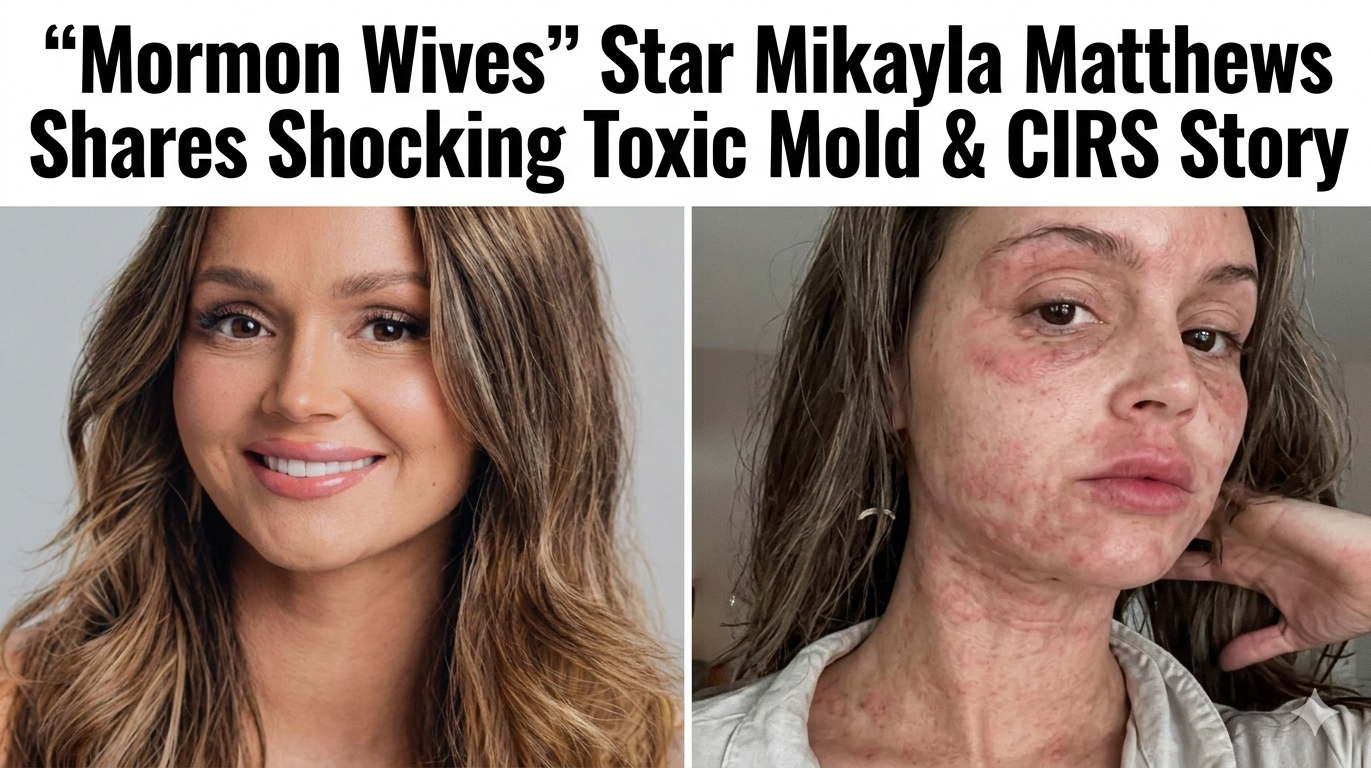
People often think mold only affects buildings. They don’t expect it to affect the body.
Yet Mikayla Matthews says it played a major role in her health problems at age 26.
Following the release of the latest season of Mormon Wives, Matthews broke down in tears as she revealed that contracting mold poisoning had contributed to the worst health flare she had experienced in over a “year and a half” — noting she had been filming at just four weeks postpartum during this period.
“I’ll be sharing more soon about my journey with mold illness, moving out of my house, and the postpartum guilt I struggled with while going through such a massive health flare filming that wasn’t included in the show,” she wrote in a recent Instagram post.
In a series of deeply personal Instagram Stories posted on March 18, 2026, Matthews publicly named her diagnosis for the first time: Chronic Inflammatory Response Syndrome, or CIRS — a condition she says was brought on by prolonged exposure to toxic mold in her own home.
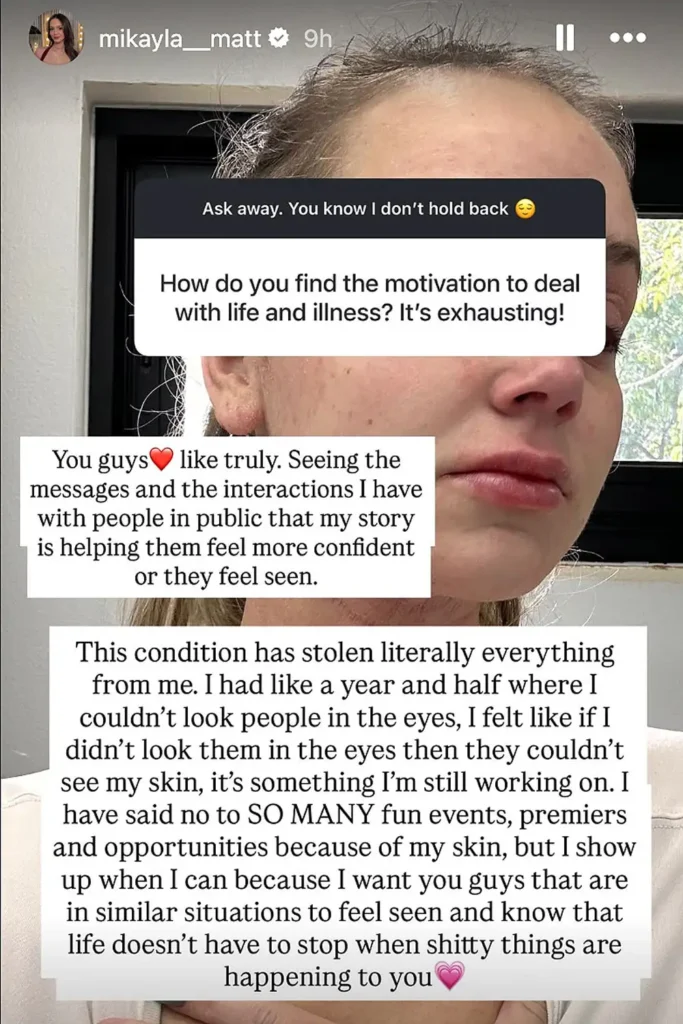
Matthews directly answered a fan’s question on Instagram Stories: “What’s your condition called?” Her response was clear and alarming:
“‘CIRS’ chronic inflammatory response syndrome. Brought on [by] prolonged exposures to toxins (mold). It has ruined just everything in my body. Nerves, skin, hair, brain, gut, liver, hormones, etc.”
She elaborated that the illness had “stolen literally everything” from her, including her ability to make eye contact with people for over a year due to the visible effects of her skin condition.
She also disclosed that she had moved out of her home as a direct result of the mold contamination.
Matthews’ description — nerves, skin, hair, brain, gut, liver, hormones — is not an exaggeration. It is medically consistent with how mycotoxins behave once they enter the body.
Mycotoxins are lipophilic, meaning they dissolve in fat. This allows them to cross the blood-brain barrier, where they can damage astrocytes, trigger neuroinflammation, and impair cognitive function.
Research shows neurological symptoms such as brain fog, multiple chemical sensitivity, fatigue, and musculoskeletal pain were significantly more prevalent in mold-exposed individuals compared to healthy controls, with a relative risk of 6.63.
peer-reviewed research from Harvard’s School of Public Health — continues to document measurable immune responses in individuals exposed to mold in buildings, lending scientific weight to the experiences of patients like Matthews.
A 2013 study of 112 patients with chronic fatigue syndrome found that 93% tested positive for at least one mycotoxin, with significantly elevated levels compared to healthy controls.
These findings suggest mold exposure may be a significant and underappreciated driver of complex, multi-system chronic illness.
A 2014 study published in PubMed also identified structural brain abnormalities in patients with CIRS acquired from water-damaged buildings.
Her revelations have sparked a wider conversation about an illness that remains poorly understood, frequently misdiagnosed, and devastating for those who live with it.
Mikayla Matthews’ health story did not begin with a clear mold diagnosis. It began with years of confusing, escalating symptoms that no single doctor could explain.
After her third child and subsequent breast implants in March 2023, Matthews developed worsening skin rashes, head-to-toe hives, open wounds, and shakes. She was placed on steroids three separate times and gained 12 pounds of fluid-related inflammation.
When she stopped the steroids, her symptoms returned worse than before. She also discovered she had mercury toxicity from dental fillings, and in 2024, she removed her implants, the infected root canal, and her mercury fillings — what she described as “removing all toxic things, both from my body and my life”.
Still, she kept getting sicker.
It was only after discovering that her home had a serious mold problem that the pieces fell into place. She has since moved out of the residence and is now working to rebuild her health. “I’m genuinely just barely surviving,” she wrote on March 18, 2026.

Toxic mold illness and CIRS are routinely overlooked by mainstream medicine.
Patients present with a confusing, shifting constellation of symptoms — skin rashes, fatigue, brain fog, hormonal imbalance, nerve pain — that can mimic dozens of other conditions.
Without a detailed environmental history and specific testing, doctors may dismiss patients as anxious, psychosomatic, or simply unlucky.
Mikayla Matthews’ willingness to name her disease, describe its devastation, and speak publicly about moving out of her home is a rare form of health advocacy.
Matthews is not just a reality TV personality, celebrity, or influencer sharing her toxic mold battle.
She is now one of many people who spent years getting sicker without knowing why—and she’s using her platform to help others recognize the warning signs sooner than she did.
For every public figure who speaks out about mold illness, there are thousands of people quietly suffering from unexplained symptoms—people who have been told they’re fine, dismissed by others, and who have spent years and significant money searching for answers.
References
-
Matthews, Mikayla. Instagram Stories, March 18, 2026. @mikayla__matt
-
Matthews, Mikayla. Instagram Post. March 13, 2026. https://www.instagram.com/p/DVxjlAkFAqc/
-
Hamilton, D. “Understanding Mycotoxin-induced Illness: Part 1.” PubMed, 2022. https://pubmed.ncbi.nlm.nih.gov/36069791/
-
Shoemaker, R.C. “Structural Brain Abnormalities in Patients with Inflammatory Illness Acquired Following Exposure to Water-Damaged Buildings.” PubMed, 2014. https://pubmed.ncbi.nlm.nih.gov/24946038/
-
Kritas, S.K. et al. “Impact of Mold on Mast Cell-Cytokine Immune Response.” Journal of Biological Regulators and Homeostatic Agents, 2018. https://pubmed.ncbi.nlm.nih.gov/30043558/
-
Lieberman, A. “Mold Exposure and Mitochondrial Antibodies.” PubMed, 2020. https://pubmed.ncbi.nlm.nih.gov/32088666/
-
PMC / NIH. “Mold, Mycotoxins and a Dysregulated Immune System.” November 2021. https://pmc.ncbi.nlm.nih.gov/articles/PMC8619365/

0 Comments