
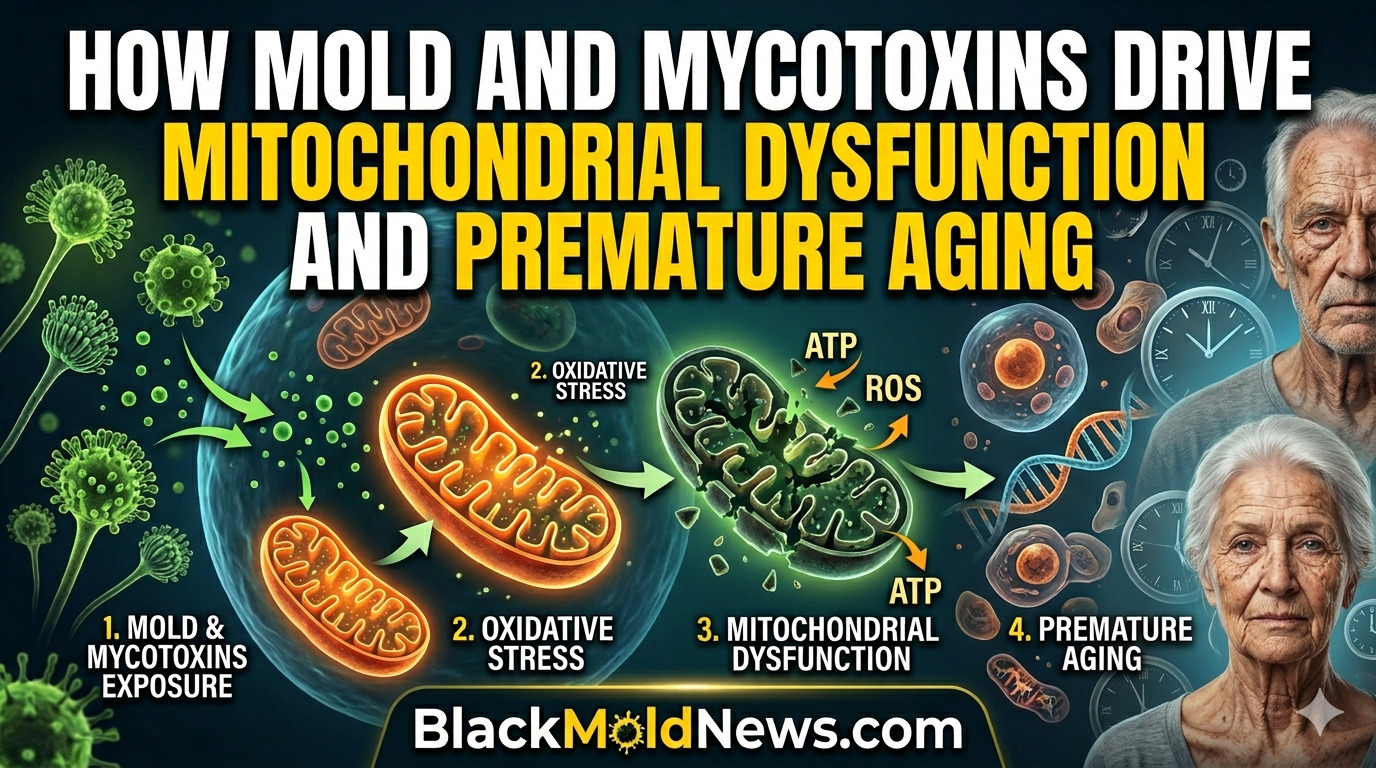
The connection between mold exposure and premature aging is one of the most underreported stories in modern environmental health.
Mounting research shows that mycotoxins attack the mitochondria — the energy-generating structures inside every cell — setting off a cascade of damage that mimics and accelerates the aging process at its most fundamental level.
Mycotoxins are secondary metabolites produced by certain species of mold that are used as toxic weapons to compete against bacteria and other organisms in their environment. Unfortunately for humans, these same compounds are highly toxic to their cells.
To understand how mycotoxins accelerate aging, you first need to understand what mitochondria do. Every cell in your body (with the exception of red blood cells) contains hundreds to thousands of mitochondria.
Their primary job is to convert oxygen and nutrients into ATP — adenosine triphosphate — the energy currency that powers every biological function in your body.
Mitochondria accomplish this through a multi-step process called oxidative phosphorylation, which takes place along the electron transport chain (ETC) — a series of protein complexes embedded in the inner mitochondrial membrane.
Electrons are passed down the chain, and their energy is used to pump protons across the membrane, ultimately driving the synthesis of ATP.
When this system runs correctly, the body generates enormous amounts of energy with minimal waste. When it is disrupted — even slightly — the consequences ripple through every organ system in the body.
Researchers at rthm.com explain it directly:
“Mitochondria are responsible for producing adenosine triphosphate (ATP), the energy currency required for every physiological process in the body”.
The loss of that energy-generation capacity is a core driver of both disease and aging.
How Mycotoxins Dismantle the Mitochondria
Research published in Toxicology (2010) demonstrated that Fusarium mycotoxins enniatin and beauvericin cause mitochondrial dysfunction by affecting mitochondrial volume regulation, oxidative phosphorylation, and ion homeostasis. These compounds depleted mitochondrial transmembrane potential, uncoupled oxidative phosphorylation, and induced mitochondrial swelling — essentially paralyzing the energy production system at submicromolar concentrations.
A 2018 review published in PubMed found that mycotoxins such as citrinin, aflatoxin, and T-2 toxin exert multi-faceted toxic effects on test systems, directly causing mitochondrial dysfunction, and concluded that “mycotoxins can induce oxidative stress even at low concentration/dose that may be one of the major causes of mitochondrial dysfunction”.
The damage works through several distinct but interconnected mechanisms:
Disruption of the Electron Transport Chain
Mycotoxins physically disable the protein complexes that generate ATP. Trichothecenes (the toxins produced by Stachybotrys chartarum) bind to the 60S ribosomal subunit, inhibiting mitochondrial protein synthesis — meaning the mitochondria literally cannot repair their own internal machinery.
These toxins also directly inhibit Complex II (Succinate Dehydrogenase), breaking the Krebs Cycle at one of its critical steps.
Ochratoxin A (OTA) has been shown in research reviewed in 2011 to cause mitochondrial toxicity and inhibit the electron transport chain — the primary energy production pathway. OTA also increases a mitochondrial antioxidant system, which itself reflects damage occurring to the mitochondria as the cell attempts to compensate.
Mycotoxins including Ochratoxin A and trichothecenes “physically disrupt the electron transport chain, the series of protein complexes inside the mitochondria that generate ATP, leading to a catastrophic drop in cellular energy production”.
The Reactive Oxygen Species (ROS) Storm
When the electron transport chain is disrupted, it doesn’t simply stop producing energy. It begins leaking electrons. These escaped electrons combine with oxygen to form reactive oxygen species (ROS) — unstable, highly reactive molecules commonly known as free radicals.
When mycotoxins impair the electron transport chain, the mitochondria begin to leak reactive oxygen species (ROS), causing severe oxidative stress that damages mitochondrial DNA and surrounding cellular structures, further impairing energy output.
Aflatoxin B1, in particular, induces massive ROS generation, causing oxidative damage to mitochondrial DNA (mtDNA).
This is where the story gets critical for aging: unlike nuclear DNA, which has robust repair mechanisms, mitochondrial DNA has very limited repair capacity. Aflatoxin-induced damage leads to permanent mutations and “energy failure” in daughter cells — meaning the dysfunction is passed down as cells divide.
The damage is not just current; it is inherited.
The relationship between mitochondrial damage and ROS generation is described in a 2024 PubMed study as fundamentally self-reinforcing:
“The reciprocal relationship between mitochondrial damage and ROS generation is evident as ROS can instigate structural and functional deficiencies within the mitochondria. Consequently, the impaired mitochondria facilitate the release of ROS, thereby intensifying the cycle of damage and exacerbating the overall process”.
The Cell Danger Response: Going Into Hibernation
When mitochondria are sufficiently poisoned, the cell activates what researchers call the Cell Danger Response (CDR) — a defensive, hypometabolic state in which the cell essentially shuts down normal operations to conserve resources.
Mycotoxins from Aspergillus, Stachybotrys, and Chaetomium are described as “potent mitochondrial poisons” that systematically dismantle the Electron Transport Chain, forcing cells into this hypometabolic CDR state.
In patients with Myalgic Encephalomyelitis/Chronic Fatigue Syndrome (ME/CFS), this biological mechanism “perfectly mirrors the experience of post-exertional malaise (PEM)” — when the body attempts to exert energy, the poisoned mitochondria cannot meet the demand, resulting in a severe, prolonged cellular energy crash.
The Aging Connection: When Cells Stop Working Right
Premature aging is not just about wrinkles or gray hair.
At the cellular level, aging is defined by a set of interconnected processes: mitochondrial dysfunction, DNA damage, telomere shortening, and cellular senescence. Mycotoxins interfere with all of these pathways simultaneously.
Cellular senescence is the process by which a damaged cell stops dividing but refuses to die. These “zombie cells” persist in tissue, unable to contribute normally but continuously secreting inflammatory signals.
A landmark 2023 PubMed study confirmed that mycotoxins have the potential to induce cell senescence, finding that “mycotoxins induce cell senescence after DNA damage, and activate signaling via the NF-κB and JNK pathways to promote the secretion of senescence-associated secretory phenotype (SASP) cytokines including IL-6, IL-8, and TNF-α”.
The SASP — Senescence-Associated Secretory Phenotype — is essentially a toxic chemical cloud that senescent cells emit. It damages neighboring healthy cells, accelerates local inflammation, and degrades tissue integrity.
Research published in 2026 in International Journal of Molecular Sciences confirmed that genotoxic mycotoxins are among the environmental exposures that can trigger cellular senescence, and that “the accumulation of non-repaired DNA damage triggering CSEN following external genotoxic exposures may contribute significantly to the amelioration of senescent cells and organ failure with age in humans”.
Telomere Damage: Shortening the Cellular Lifespan
Telomeres are the protective caps at the ends of chromosomes — essentially biological timekeepers that shorten each time a cell divides. When telomeres become too short, cells stop dividing, die, or become senescent. Shortened telomeres are one of the most reliable biological markers of accelerated aging.
Mycotoxin-induced oxidative stress directly damages telomeres. Free radicals generated by disrupted mitochondria cause strand breaks in DNA, and telomeric regions are particularly vulnerable because they have limited repair machinery. The same 2026 senescence study noted that DNA damage caused by genotoxic exposures — including mycotoxins — drives telomere dysfunction as part of the broader cellular senescence pathway. As the study concluded, “since CSEN correlates with aging, it is reasonable to conclude that exogenous genotoxic pollutants contribute significantly to the aging process through CSEN induction”.
Antimitochondrial Antibodies: When the Body Attacks Itself
One of the most alarming findings in mold illness research involves antimitochondrial antibodies (AMA) — a condition in which the immune system begins attacking the body’s own mitochondria.
A 2020 study published in PubMed examined the prevalence of AMA in patients exposed to molds, mycotoxins, and other toxins. The existence of these antibodies suggests that mycotoxin-induced mitochondrial damage is so severe that the immune system begins treating mitochondria as foreign invaders.
This autoimmune response further compounds the mitochondrial dysfunction, creating a situation where the body is simultaneously being poisoned by external mycotoxins and attacked from within by its own defenses.
The Neurodegenerative Dimension
The brain is especially vulnerable to mycotoxin-induced mitochondrial dysfunction because neurons have an extraordinarily high energy demand.
A 2025 study in PubMed examined the evidence linking mycotoxin exposure to neurodegenerative disorders like Alzheimer’s and Parkinson’s diseases, exploring “mechanisms such as oxidative stress, mitochondrial dysfunction, blood-brain barrier disruption, neuroinflammation, and direct neurotoxic effects”.
Ochratoxin A exposure has been specifically associated with “dopaminergic neurodegeneration and neuronal apoptosis, particularly in the striatum, substantia nigra, and hippocampus, regions often affected in Parkinson’s disease”. The primary toxic mechanisms of aflatoxin B1 in the brain include “excessive ROS production, oxidative stress, apoptosis, mitochondrial dysfunction, and heightened neuroinflammation”.
A 2026 review published in the Journal of Integrative Neuroscience noted that because mycotoxins affect mitochondrial function and cause cell death, they destroy fat cells and therefore do not accumulate in them — instead remaining active in fat-rich tissues like the brain.
This means brain cells face prolonged, direct mycotoxin exposure that other tissues may not.
Skin, Collagen, and Visible Aging
The effects of mycotoxin-induced mitochondrial dysfunction also manifest visibly on the skin. Mitochondria play a critical role in collagen synthesis — and when they fail, structural proteins fail with them.
Mycotoxins interfere with the body’s ability to produce proteins like keratin, elastin, and collagen, which are key to maintaining the firmness and youthful appearance of skin. When mycotoxins obstruct the creation of these proteins, the skin ages more quickly and becomes dry.
Mycotoxins also disrupt hormone receptors, causing the body to behave as though it has entered premature menopause or andropause — accelerating the hormonal component of aging regardless of the patient’s actual age.
Indoor air pollutants including mold contribute to chronic inflammation that drives “redness, irritation, and further breakdown of collagen and elastin — the chief constituents of young, healthy skin”.
Prevention and Practical Action
Understanding the biological mechanisms behind mold-induced aging should motivate urgency in how we manage indoor environments. Here is what the science supports:
Eliminate the source first. No supplement protocol or detox regimen will overcome active, ongoing mycotoxin exposure. According to the EPA, “the way to control indoor mold growth is to control moisture”.
Fix all leaks, dry water damage within 24–48 hours, and keep indoor humidity below 50%.
Test before you assume. If you are experiencing unexplained fatigue, brain fog, accelerated skin aging, or systemic inflammation, urinary mycotoxin testing can identify specific toxins present in the body.
Testing for antibodies to molds is less clinically relevant than direct mycotoxin testing.
Support mitochondrial repair. Rebuilding mitochondrial function requires specific cofactors that protect and repair the electron transport chain, including CoQ10, PQQ, NAD⁺, alpha-lipoic acid, phosphatidylcholine, and glutathione. N-acetyl cysteine (NAC), a glutathione precursor, has been shown in research to significantly block some of the negative effects of ochratoxin A on human cells.
Use toxin binders strategically.
Activated charcoal and cholestyramine work by adsorbing mycotoxins in the gastrointestinal tract, preventing their reabsorption and facilitating elimination. These should be used under clinical supervision.
Seek professional inspection and remediation.
The CDC concurs with the EPA’s recommendation that mold contamination in indoor environments must be properly remediated to prevent negative health effects. Certified industrial hygienists and licensed mold remediation contractors should be consulted when contamination is significant.
Consider professional medical evaluation. Environmental and occupational medicine specialists can evaluate antimitochondrial antibody levels, mycotoxin biomarkers, and inflammatory markers. Emerging approaches including low-dose naltrexone, peptide therapies, and hyperbaric oxygen treatment are being explored as adjunctive treatments for mold-related mitochondrial dysfunction.
Conclusion
The human body was not designed to sustain chronic mycotoxin exposure.
When mold infiltrates an indoor environment, it introduces a class of chemicals capable of attacking the most fundamental structures of cellular life. The mitochondria — once functioning as efficient energy factories — become damaged, leaking, and dysfunctional. Reactive oxygen species overwhelm the cell’s defenses.
DNA accumulates damage that cannot be repaired.
Cells enter senescence and begin broadcasting inflammatory distress signals that age neighboring tissues.
Collagen breaks down.
Hormones dysregulate.
The brain’s neurons, starved for energy, begin to fail.
This is not a slow, abstract process.
It is happening at a cellular level in millions of people living and working in water-damaged buildings right now — many of whom have never connected their symptoms to the environment they breathe every day.
The science is clear: mold and mycotoxins are accelerators of biological aging, operating far below what the naked eye can see.
Awareness is the first intervention.
Testing is the second.
And removing the source of exposure is the most powerful therapeutic step available.
The research reviewed here points to one urgent message: the health of your mitochondria depends, in part, on the health of your indoor environment.
References
-
Islam, M.T. (2018). “Mycotoxin-assisted mitochondrial dysfunction and cytotoxicity.” PubMed. https://pubmed.ncbi.nlm.nih.gov/30180298/
-
Tonshin, A.A. et al. (2010). “The Fusarium mycotoxins enniatins and beauvericin cause mitochondrial dysfunction.” Toxicology. https://pubmed.ncbi.nlm.nih.gov/20621153/
-
Nie, T. et al. (2025). “A potential etiological factor for neurodegenerative diseases?” PubMed. https://pubmed.ncbi.nlm.nih.gov/39814257/
-
Lieberman, A. (2020). “Mold Exposure and Mitochondrial Antibodies.” PubMed. https://pubmed.ncbi.nlm.nih.gov/32088666/
-
Mishra, S. et al. (2024). “Deoxynivalenol Induces Drp-1-Mediated Mitochondrial Dysfunction.” PubMed. https://pubmed.ncbi.nlm.nih.gov/38875017/
-
Li, J. et al. (2023). “Mycotoxins have a potential of inducing cell senescence.” PubMed. https://pubmed.ncbi.nlm.nih.gov/37331672/
-
Cellular Senescence Triggered by Food and Environmental Genotoxins. (2026). Int J Mol Sci. https://pubmed.ncbi.nlm.nih.gov/41828605/
-
Mold and Mycotoxin Exposure and Brain Disorders. (2023). IMR Press. https://www.imrpress.com/journal/JIN/22/6/10.31083/j.jin2206137
-
Review of Injury and Treatment for Illness in Water-Damaged Buildings. (2013). PMC. https://pmc.ncbi.nlm.nih.gov/articles/PMC3654247/
-
U.S. Environmental Protection Agency. “Can mold cause health problems?” https://www.epa.gov/mold/can-mold-cause-health-problems
-
U.S. Environmental Protection Agency. “A Brief Guide to Mold, Moisture and Your Home.” https://www.epa.gov/mold/brief-guide-mold-moisture-and-your-home
-
CDC. “State of the Science on Molds and Human Health.” https://stacks.cdc.gov/view/cdc/142218/cdc_142218_DS1.pdf
-
RTHM. “Mold and Mycotoxin Illness: Its Connection to ME/CFS, MCAS.” https://www.rthm.com/resources/blogs/mold-mycotoxins-chronic-illness
-
Grassroots Functional Medicine. “Mold & Mycotoxins: The Hidden Epidemic.” https://grassrootsfunctionalmedicine.com/blog/mold-mycotoxins-the-hidden-epidemic-sabotaging-your-health/
-
Dr. Todd Maderis. “Mold Illness is More Than a Chronic Inflammatory Response Syndrome.” https://drtoddmaderis.com/chronic-inflammatory-response-syndrome
-
Hypercharge Health. “The Mitochondrial Winter: How Mycotoxins Hijack Human Energy Production.” https://www.hyperchargehealth.com/blog/the-mitochondrial-winter-how-mycotoxins-hijack-human-energy-production
-
Medicine Magazine. “Medical treatments for mold toxicity.” https://www.medicinemagazine.info/medical-treatments-for-mold-toxicity/
-
Exposure to Mycotoxins: Neurological Disorders and Psychiatric Conditions. (2026). LIDSEN. https://www.lidsen.com/journals/neurobiology/neurobiology-10-01-322

0 Comments