
Most people know that smoking causes lung cancer. Most people know that sun exposure causes skin cancer.
But very few people — including many in the medical community — know that the mold living in their walls, growing in their food, and colonizing inside their bodies is increasingly linked to some of the most deadly cancers on the planet.
This isn’t fringe science. This isn’t alternative medicine.
This is peer-reviewed research published in journals like Cell, Cancer Cell, and the IARC Monographs. And the more researchers dig into the relationship between fungi, their toxic byproducts, and human cancer, the more alarming the picture becomes.
As someone who has spent years investigating mold-damaged buildings and educating families about the hidden dangers of indoor fungi, I want to walk you through what the science actually says — not what gets filtered down to a public health pamphlet, but what the studies themselves reveal.
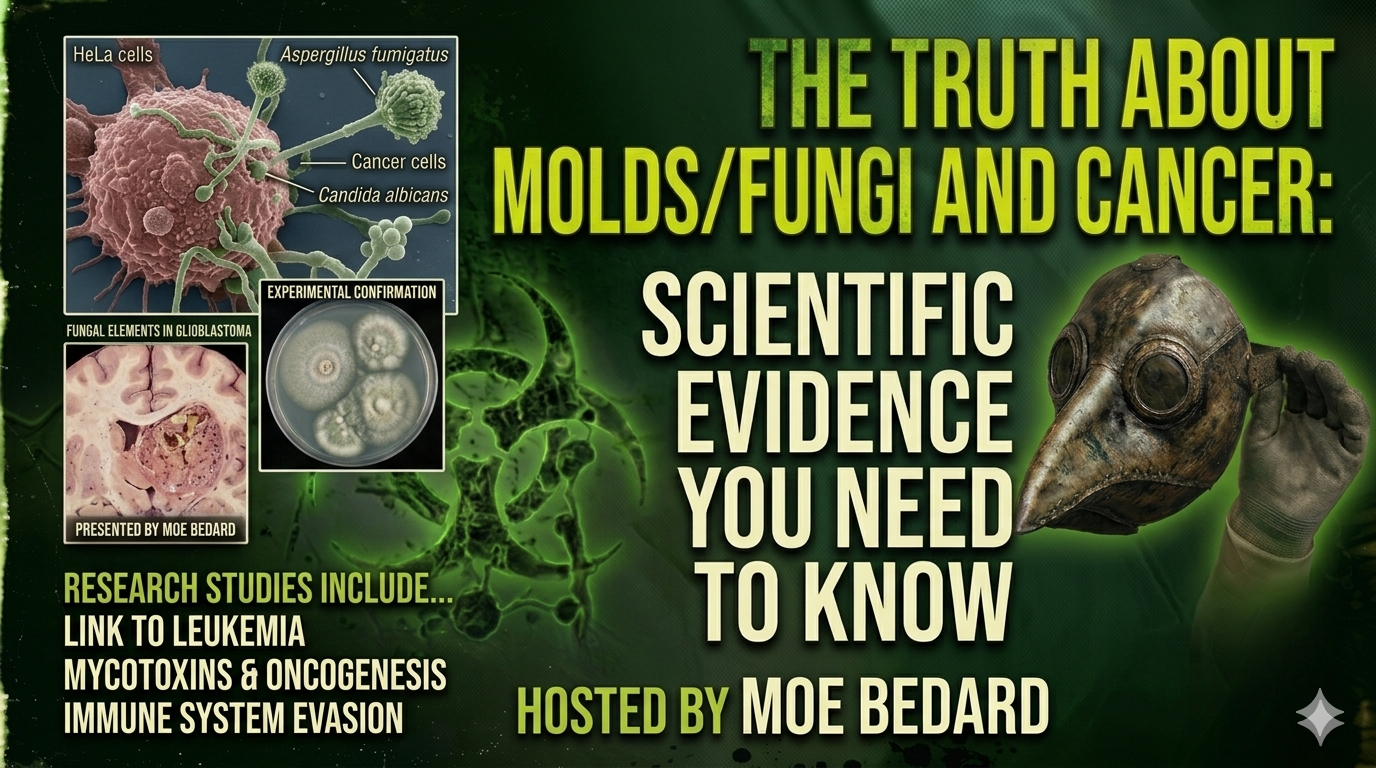
In the past several years, scientists have discovered that fungi don’t just threaten the body from the outside.
They are found inside tumors themselves.
Using advanced sequencing techniques, researchers have confirmed the presence of fungal DNA and cells in tissue samples from multiple cancer types — including pancreatic, colon, stomach, lung, and head-and-neck cancers.
According to epidemiological research, microbial infection — of which fungal infection is now an acknowledged part — is responsible for initiating an estimated 2.2 million new cancer cases per year globally.
A 2022 review in a peer-reviewed journal provided a comprehensive framework connecting fungal infections to esophageal, gastric, colorectal, lung, cervical, skin, and ovarian cancers, noting that “based on epidemiological evidence, there is a clear link between pathogenic fungal infections and cancer development.”
A 2025 comprehensive review in PubMed synthesizing the current state of the science concluded: “Cancer-associated fungal populations could be utilized as a target for a combination therapy involving the integration of anticancer and antifungal drugs as well as inhibitors of fungal morphogenesis to develop more effective anticancer therapies.”
The researchers further observed that fungi and cancer cells share a remarkable parallel: “Inhibiting differentiation causes apoptosis in fungi, whereas preventing apoptosis leads to cancer in multicellular organisms.”
The biology of fungi and the biology of cancer, it turns out, are closer than anyone expected.
In 2022, a study published in the journal Cell confirmed something that, even a decade ago, would have been considered impossible: fungi live inside human tumors.
Narunsky-Haziza and colleagues analyzed fungal DNA and cellular material in tissue from 17,401 patients spanning 35 different cancer types across four independent research cohorts. They found fungi consistently present across cancer types — approximately one fungal cell for every 10,000 human tumor cells. That might sound like a small number, but in the context of tumor biology, it is enormous.
The question is not just whether fungi are present in tumors. The question is what they are doing there. And the answer, emerging from multiple research lines, is that they are actively helping the cancer.
The American Association for Cancer Research summarized the findings this way in 2022: “Interactions between fungi and surrounding bacterial communities correlated with outcomes,” meaning that the composition of the fungal community inside a tumor influenced how aggressive that tumor became and how likely the patient was to survive.
Different fungal species appear to behave differently across cancer types.
Candida species were associated with inflammation and tumor-promoting gene expression changes in gastric, head-and-neck, and colon cancers. Aspergillus was associated with adverse outcomes in lung cancer.
The picture is complex, species-specific, and still being mapped — but the central conclusion is clear: fungi inside tumors are not passive bystanders.
They are active participants in cancer biology.
What makes this extraordinary is not just the presence of fungi in tumors, but what those fungi appear to be doing once they get there.
The Candida group, for example, was associated with inflammation and immune activation in stomach cancer, tumor-promoting gene expression changes in head-and-neck and colon cancers, and reduced survival in various gastrointestinal cancers.
The researchers found that “interactions between fungi and surrounding bacterial communities correlated with outcomes,” suggesting that the fungal-bacterial ecosystem inside a tumor shapes how aggressive that tumor becomes.
Research published in Cancer Cell in 2022 by Alam et al. made a stunning discovery: the intratumoral fungal mycobiome directly drives tumor progression in pancreatic cancer.
The study found that the fungus Malassezia was the most abundant genus found in PDAC tumors — significantly more prevalent than in normal pancreatic tissue.
Even more critically, the researchers showed that these intratumoral fungi trigger the secretion of a pro-inflammatory protein called IL-33 from cancer cells. IL-33 then recruits type 2 immune cells (TH2 cells and ILC2 cells) into the tumor microenvironment — where, instead of fighting the cancer, they promote tumor growth.
The implications are profound.
When mice were treated with the antifungal drug amphotericin B, tumor burden significantly decreased. When specific fungal species were introduced, tumor growth accelerated.
As the study abstract states: “Genetic deletion of IL-33 or anti-fungal treatment decreases TH2 and ILC2 infiltration and increases survival.”
This finding — that simply treating fungi inside a tumor can slow its growth — represents a potential new frontier in cancer therapy that we are only beginning to understand.
The Molecular Mechanisms: How Fungi Drive Carcinogenesis
It is worth pausing to understand exactly how mycotoxins and intratumoral fungi drive cancer at the molecular level, because this is where the science becomes both precise and undeniable.
To understand how fungi drive cancer, you need to understand that there are two distinct mechanisms at play — and both of them are dangerous.
The first is mycotoxins.
These are toxic chemical compounds secreted by molds, including species like Aspergillus, Penicillium, and Fusarium. When people ingest, inhale, or absorb these compounds, mycotoxins can directly damage DNA, knock out tumor suppressor genes, corrupt the body’s cellular repair systems, and push normal cells down the road toward malignancy.
This pathway has been studied for decades, and the evidence is rock solid.
The research on combined mycotoxin exposure is alarming.
A comprehensive review in Cancer Causes & Control identified “potential synergisms between mycotoxins with regard to carcinogenic attributable risk” as a critical and understudied area. A 2024 study in PLOS ONE confirmed that “exposure to multiple mycotoxins may have a potentially increased carcinogenic effect over single mycotoxins.”
If you want to understand why mycotoxins matter, start with aflatoxin B1 — commonly called AFB1. It is produced by two molds, Aspergillus flavus and Aspergillus parasiticus, which contaminate corn, peanuts, tree nuts, and cottonseed, particularly in warm, humid storage conditions.
This mold is also one of the most common found growing in water damaged homes on drywall,, flooring, and wood etc.
The International Agency for Research on Cancer — a branch of the World Health Organization — classified naturally occurring aflatoxins as Group 1 human carcinogens in 1993.
That is the highest classification possible.
It means there is sufficient evidence in both human populations and experimental animal studies that the substance causes cancer in people. That classification has been confirmed in every subsequent review.
Ochratoxin A, or OTA, deserves far more attention than it gets. It is produced primarily by Aspergillus ochraceus and Penicillium verrucosum — two molds that contaminate grains, coffee, dried fruits, wine, and, critically for anyone concerned about indoor air quality, water-damaged buildings.
The IARC classified OTA as a Group 2B carcinogen in 1993, meaning it is possibly carcinogenic to humans, with sufficient animal evidence of carcinogenicity. More recently, the U.S. National Toxicology Program took a stronger stance, listing OTA as “reasonably anticipated to be a human carcinogen” in its 15th Report on Carcinogens.
The animal data is overwhelming. Research from the National Toxicology Program showed that OTA produced some of the highest incidences of kidney tumors ever recorded in an NTP carcinogenesis study, with approximately one-third of high-dose male rats developing metastatic renal carcinomas.
The researchers concluded that OTA is “a potent renal carcinogen in the rat and suggests that contamination of feedstuff by this mycotoxin may pose a potential hazard to domestic animals and man.”
The second mechanism is newer and — if anything — even more unsettling. Fungi don’t just attack the body from the outside.
Researchers have now confirmed that fungi colonize tumors themselves, embedding in cancer tissue and actively manipulating the immune system to help tumors grow, spread, and resist treatment.
Both pathways are real. Both are dangerous. And together, they represent one of the most underappreciated threats in modern oncology.
Researchers have now documented at least four distinct molecular pathways through which fungi and their metabolites cause or accelerate cancer:
-
Direct DNA damage: AFB1 forms DNA adducts that cause mutations in the p53 tumor suppressor gene, allowing damaged cells to proliferate unchecked.
-
Cell cycle disruption and apoptosis inhibition: Fumonisin B1 inhibits ceramide synthase, blocking sphingolipid-mediated apoptosis and allowing pre-cancerous cells to survive.
-
Epigenetic modifications: Ochratoxin A induces changes in DNA methylation and histone modifications that can silence tumor suppressor genes or activate oncogenes — essentially reprogramming cells toward malignancy without changing the underlying DNA sequence.
-
Immune system manipulation: Intratumoral fungi like Malassezia and Alternaria hijack the immune system’s own signaling pathways, recruiting pro-tumor immune cells and helping cancer evade detection and treatment.
Here is what makes the mycotoxin threat especially difficult to control: people are not exposed to one mycotoxin at a time. They are exposed to multiple mycotoxins simultaneously — through food, through the air in water-damaged buildings, and through a combination of both.
Aflatoxins and fumonisins, for example, commonly co-occur in maize — the world’s most widely consumed grain. According to the Weill Cornell review:
“The synergistic interactions between various mycotoxins, along with other environmental and dietary factors, significantly amplify their toxicity and complicate public health risks… their combined presence enhances the carcinogenic potential beyond the effects of each toxin alone.”
The metabolic interactions deepen the risk. The metabolites of one mycotoxin can enhance the toxic effects of another. T
he immune system, already suppressed by certain mycotoxins, becomes more vulnerable to the next toxin in the chain. Disruptions in gut microbiota and impaired liver detoxification processes reduce the body’s ability to clear any of them.
Nutritional deficiencies — particularly in proteins, vitamins, and minerals — worsen these effects by reducing the body’s capacity to detoxify mycotoxins, increasing vulnerability to chronic diseases, including cancer.
This is why populations in developing nations with limited food safety infrastructure and nutrient-poor diets face the highest cancer burden from mycotoxin exposure.
But it would be a mistake to believe this is only a developing-world problem.
The same biological mechanisms operate in any body chronically exposed to multiple mycotoxins — including American bodies living in water-damaged homes and eating the standard American diet.
Conclusion
We are standing at a turning point in our understanding of cancer.
For decades, the medical and public health establishment focused primarily on chemical carcinogens, tobacco, radiation, and viruses.
Fungi were an afterthought — pathogens associated with infections in immunocompromised patients, not with cancer in otherwise healthy adults.
That picture is changing rapidly. The science is now clear that aflatoxin B1 is one of the most potent carcinogens ever identified in nature. Ochratoxin A and fumonisin B1 are driving kidney and esophageal cancers in populations around the world.
Multiple mycotoxins acting together may create carcinogenic synergies we have only begun to measure. And fungi living inside tumors are actively manipulating the immune system to help cancer grow and survive.
As a 2025 paper published in PubMed summarized: “Cancer-associated fungal populations could be utilized as a target for a combination therapy involving the integration of anticancer and antifungal drugs as well as inhibitors of fungal morphogenesis to develop more effective anticancer therapies.”
This is not a distant possibility. This is where cancer research is heading right now.
Here is what concerns me most about mycotoxins: it is not just a food safety problem.
The studies reviewed in this article were largely conducted in the context of dietary exposure — aflatoxin in African food supplies, fumonisin in corn-dependent communities, ochratoxin in European grain storage.
Aspergillus grows on water-damaged insulation and drywall. Penicillium colonizes wet wall cavities and paper-backed materials. Fusarium has been documented in HVAC systems and water-damaged building materials. These are not exotic agricultural contaminants. They are extremely common indoor molds found in homes and buildings across America.
A resident of a water-damaged home is not eating a single contaminated meal.
They are inhaling aerosolized mycotoxins every day — while they sleep, while they cook, while their children do homework.
They are breathing highly cancienic mycotoxins like aflatoxin B1 and Ochratoxin A every single day.
The chronic inhalation exposure that comes with living in a mold-contaminated home has never been fully modeled from a cancer risk standpoint, and that gap in our knowledge should deeply concern every public health professional in America.
How many people who have cancer have been really infected with molds and mycotoxins from the air they breathe.
The cumulative, chronic, multi-toxin exposure that comes with living in a mold-contaminated building is precisely the kind of exposure model that the toxicology literature identifies as most concerning.
And it is happening to millions of Americans right now.
The facts are that the mold growing in your walls is not just making you sick today.
It may be shaping your cancer risk for decades to come.
That is a fact every homeowner, every renter, every parent, and every policymaker needs to take seriously.
References
-
Claeys, L. et al. (2020). “Mycotoxin exposure and human cancer risk: A systematic review of epidemiological studies.” Comprehensive Reviews in Food Science and Food Safety. https://pubmed.ncbi.nlm.nih.gov/33337079/
-
Ostry, V. et al. (2017). “Mycotoxins as human carcinogens — the IARC Monographs classification.” Mycotoxin Research. https://pubmed.ncbi.nlm.nih.gov/27888487/
-
Ekwomadu, T. et al. (2022). “Mycotoxin-Linked Mutations and Cancer Risk: A Global Health Issue.” PMC/NIH. https://pmc.ncbi.nlm.nih.gov/articles/PMC9266006/
-
Wogan, G.N. (2012). “Present and future directions of translational research on aflatoxin and hepatocellular carcinoma.” PubMed. https://pubmed.ncbi.nlm.nih.gov/21623489/
-
De Ruyck, K. et al. (2015). “Dietary mycotoxins, co-exposure, and carcinogenesis in humans.” Cancer Letters. https://pubmed.ncbi.nlm.nih.gov/26596546/
-
Alam, A. et al. (2022). “Fungal mycobiome drives IL-33 secretion and type 2 immunity in pancreatic cancer.” Cancer Cell. https://pubmed.ncbi.nlm.nih.gov/35120601/
-
Narunsky-Haziza, L. et al. (2022). “Pan-cancer analyses reveal cancer-type-specific fungal ecologies and bacteriome interactions.” Cell. https://www.sciencedirect.com/science/article/pii/S0092867422011734
-
Hosseini, K. et al. (2022). “Role of Fungal Infections in Carcinogenesis and Cancer Promotion.” PMC. https://pubmed.ncbi.nlm.nih.gov/36415634/
-
Ghogare, S.S. et al. (2025). “Intratumor fungi specific mechanisms to influence cell carcinogenesis.” PubMed. https://pubmed.ncbi.nlm.nih.gov/40258837/
-
Malir, F. et al. (2016). “Ochratoxin A: 50 Years of Research.” PubMed. https://pubmed.ncbi.nlm.nih.gov/27384585/
-
Liu, Y. et al. (2012). Meta-analysis of AFB1, HBV, and HCC risk. Referenced in: https://globalhealthperspectives.com/article/aflatoxin-food-toxin-that-causes-liver-cancer
-
Yu, S. et al. (2021). “Fumonisin B1 triggers carcinogenesis via HDAC/PI3K/Akt signaling.” PubMed. https://pubmed.ncbi.nlm.nih.gov/34000555/
-
“Mycotoxins in Food: Cancer Risks and Strategies for Control.” (2024). PMC/NIH. https://pmc.ncbi.nlm.nih.gov/articles/PMC11545588/
-
National Toxicology Program. 15th Report on Carcinogens: Ochratoxin A. https://www.ncbi.nlm.nih.gov/books/NBK590879/
-
IARC. (2002). “Aflatoxins — IARC Summary & Evaluation, Volume 82.” https://www.inchem.org/documents/iarc/vol82/82-04.html
-
American Association for Cancer Research. (2022). “The Fungus Within Us: The Mycobiome’s Emerging Role in Cancer.” https://www.aacr.org/blog/2022/12/08/the-fungi-within-us-the-mycobiomes-emerging-role-in-cancer/

0 Comments