The black spots on the barracks walls were easy to see. The smell of mildew filled the hallways. But the families living inside had no idea what was slowly making them sick.
Across the U.S. military, about 700,000 service members and their families live in privatized military housing. Their rent is automatically taken from their paychecks. If serious problems appear in the home—like leaks or mold—families often have very little power to stop paying rent or move somewhere else quickly.
For many of these families, mold is more than just an ugly stain on the wall. It brings a quiet, constant fear. While service members defend the country, their spouses and children are often left fighting a different battle—trying to protect their health inside the very homes meant to support them.
Behind the polished brochures that promise “safe, affordable housing” and “family-friendly bases,” many military families tell a different story. Thousands have reported rashes, breathing problems, fatigue, headaches, and other unexplained illnesses. In many cases, these symptoms trace back to damp walls, hidden leaks, and toxic mold growing inside their homes.
For years, complaints about mold in military housing were often dismissed as isolated incidents. Some housing companies even blamed the problem on the habits of soldiers and their families.
That narrative began to change in 2022, when investigations by Military.com and internal Army documents revealed something much bigger: a widespread mold problem affecting bases across the country.
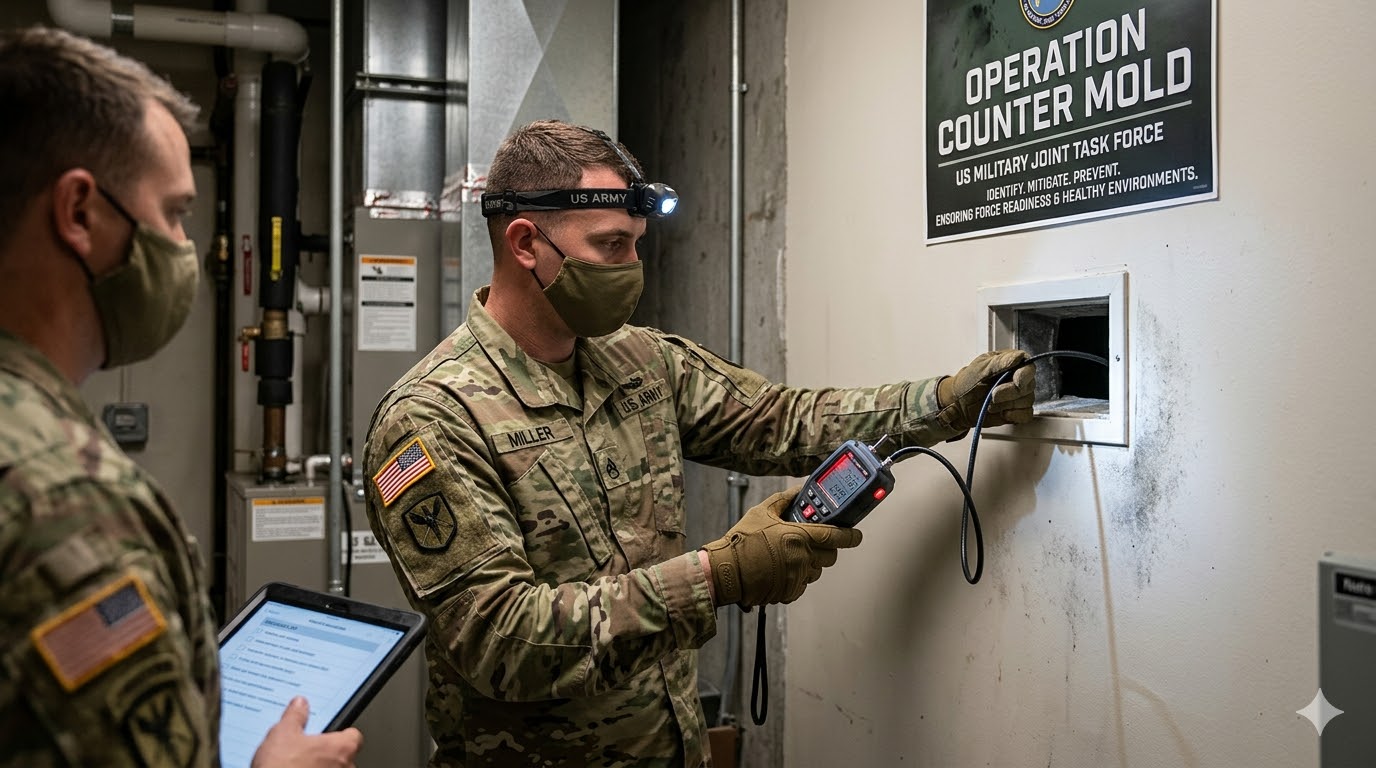
The issue was serious enough that the U.S. Army launched a formal initiative with a name that sounded more like a combat mission than a housing repair project—Operation Counter-Mold.
In early 2023, the Army quietly began this internal program. Its mission was to identify mold problems, improve cleanup efforts, and track moisture issues inside Army housing. But the program also included another goal: managing how the public and military families view the mold problem.
Internal training materials describe Operation Counter-Mold as a “multi-faceted plan” designed not only to address mold in Army housing, but also to improve “public sentiment” around the issue.
The program calls for building inspections that focus on ceilings, HVAC systems, and other areas where moisture and mold can grow behind walls. It also introduces standardized reporting systems so housing offices can track mold complaints and repair requests more closely.
At the same time, communication guidance was created for housing officials on military bases. These materials encourage staff to reassure families that “some mold” is normal in buildings and advise them to steer residents away from independent testing or outside media attention.
According to the Army’s Counter Mold 101 Communications Resource Guide, the official goal of Operation Counter-Mold is clear:
“To proactively eliminate threats to life, health, and safety from mold and improve the quality of life for people in Army facilities.”
But the operation did not begin as part of routine building maintenance. It emerged only after years of mounting pressure—from military families, whistleblowers, and investigative journalists—who exposed deteriorating barracks, persistent leaks, and mold infestations in privatized military housing across the country.
Now, Operation Counter-Mold stands as the military’s most direct attempt to confront a problem that thousands of service members and their families say has been ignored for far too long.
Operation Counter-Mold is a comprehensive initiative launched by the U.S. Army’s Installation Management Command (IMCOM) in early 2023. Its stated goal is clear: “to proactively eliminate threats to life, health, and safety from mold and improve the quality of life for people in Army facilities,” according to the official Counter Mold 101 Communications Resource Guide published by IMCOM Headquarters .
The operation was not born out of routine maintenance planning. It was a direct response to public pressure, media investigations, and a surge in mold complaints from soldiers and their families living in deteriorating barracks and privatized housing across the country.
Lt. Gen. Omar Jones IV, Commanding General of IMCOM, issued a public statement describing the operation’s goals: “Our purpose is to proactively eliminate threats to life, health, and safety from mold and improve the quality of life for people in Army facilities. This will allow IMCOM and the Army to reinforce our commitment to quality facilities and investment in our Soldiers, Families, and Civilians.”
General James C. McConville, former Chief of Staff of the U.S. Army, echoed those sentiments: “In our Army, it’s about People First and the care and quality of life for our Soldiers and their families is always forefront in our minds. We’re investing in our barracks and housing to give our Soldiers and families the quality of life that’s equal to the quality of their service.”
The Scale of the Problem
The numbers are staggering when you consider the scope of the U.S. military’s housing inventory.
The Army’s privatized and government-operated family housing alone covers approximately 87,000 units globally, and the Army fields around 280 mold mitigation specialists to cover those units, barracks, and all other Army facilities.
Between November 2022 and January 2023, Army senior leaders ordered an emergency inspection of 67,859 Army facilities — including barracks, childcare centers, and Army-owned family housing. The inspections found that 97% of facilities were mold-free, but the mold that was discovered was ordered to be immediately remediated .
Newly released documents show that the Army has recorded over 20,000 mold‑related work orders since October 2022, yet families still describe homes where mold returns months after repairs and where health problems worsen while base officials insist conditions are “safe.”
That ratio raises serious concerns. With roughly one specialist for every few hundred buildings, mold problems can grow quietly behind walls and inside HVAC systems long before a trained inspector ever walks through the door.
The problem is not limited to the Army.
A 2025 Stars and Stripes survey found that two-thirds of military family respondents reported mold problems in their homes, and almost half said housing conditions had affected their “ability to perform duties and maintain mission readiness”. The Air and Space Forces alone recorded more than 4,500 mold-related reports in privatized housing in 2024.
Some of the most widely reported hotspots include Fort Campbell, Kentucky/Tennessee, where families in privatized Army family housing have reported chronic respiratory issues, skin rashes, and neurological symptoms tied to hidden mold behind walls and in HVAC systems.
Specific installations have made national headlines:
-
Fort Bragg, North Carolina (2022): Approximately 1,100 soldiers were relocated due to severe mold in their barracks.
-
Fort Stewart, Georgia: Senior Army leaders were personally dispatched to inspect barracks after mold overtook entire living areas.
-
MacDill Air Force Base, Florida: Military families filed a lawsuit in 2025 after discovering high mold levels behind walls and inside HVAC systems, reporting repeated illnesses and unresolved maintenance requests.
-
Fort Sam Houston and Randolph Air Force Base, Texas: A 2025 Department of Defense Inspector General audit found recurring water intrusion, HVAC failures, and housing offices that lacked devices to even measure humidity levels.
Erica Thompson, a military spouse of more than 22 years, spoke before Congress in January 2026 after losing her family dog, most of her belongings, and watching all five of her children become medically disqualified from military service due to toxic mold exposure in military housing.
“Our home was contaminated with toxic mold,” Thompson testified. “The stories I have collected from families show that toxic conditions in military housing are not isolated, but a systemic failure.”
This means there is currently a massive problem with mold contamination at many of our military bases and housing units across the US so service members need to be aware and also have knowledge to protect themselves.
In response to the scandals, the military and Congress has begun to act.
The Hidden Communication Strategy
Critics argue that the phrase “Operation Counter‑Mold” itself signals a desire to counter complaints and lawsuits, not just to fix leaky roofs and broken HVAC systems.
Internal documents obtained and reported by Rolling Stone and the Project On Government Oversight (POGO) reveal a layer of Operation Counter-Mold that goes beyond fixing leaky roofs.
A January 2023 Army workshop — attended by over 100 participants including healthcare professionals, DoD partners, industry experts, and garrison leadership — produced not only mold remediation protocols, but also a “Counter Mold Communications Playbook” that included messaging strategy and social media guidance.
One internal slide from the workshop posed the question of whether mold was simply “a part of life” in military housing. The IMCOM Counter Mold 101 Resource Guide openly states that part of the operation’s mission is “constructively reframing how we all think about mold” .
Critics have pointed out a troubling contradiction: the Army advises against mold testing, citing a lack of federal mold standards — yet both EPA guidance and some military branch documents suggest testing should be conducted when there are health concerns. Independent mold inspectors working with affected families say that having third-party test results is often the only way to compel housing companies to take action.
“The reason we have success in getting families displaced and mandating specific remediation is because we’re holding the card that, ‘Here are the tests,'” one mold professional explained in reporting by Rolling Stone.
Why Military Housing Is Vulnerable
Military housing is vulnerable to mold for several intersecting reasons. Many privatized housing units were built decades ago and now run under long‑term contracts that prioritize rent collection over long‑term capital investment.
Until recently, the Department of Defense lacked enforceable standards for humidity and mold in family housing, and housing inspectors often visit only when families complain instead of running routine air‑quality or humidity checks.
Private companies collect rent automatically from military pay, but families cannot easily withhold rent or move to better housing without incurring significant financial and logistical costs.
Army documents tied to Operation Counter‑Mold acknowledge that “mold is arguably the most common maintenance issue” in its family housing portfolio, yet they also normalize it as an unavoidable part of living in many regions.
What the Army’s Own Playbook Says to Do
For homeowners and property managers, the Army’s Counter Mold 101 checklist offers a practical, room-by-room framework that applies far beyond military housing :
Prevent moisture before it starts:
-
Keep HVAC and air conditioning systems running at all times — never turn them off
-
Use exhaust fans every time you shower
-
Keep windows and blinds managed to allow airflow and light (sunlight inhibits mold growth)
-
Repair plumbing leaks and water intrusion immediately — do not delay
Inspect regularly:
-
Check walls, ceilings, window frames, and cabinet undersides for discoloration or musty odors
-
Inspect refrigerator seals and under-sink areas
-
Examine attics, crawl spaces, and HVAC duct connections — areas often missed in routine walk-throughs
Respond appropriately:
-
Small mold patches under 10 square feet can be safely cleaned using a soap solution — do not use bleach, which is ineffective at killing mold at its root
-
Mold patches over 10 square feet require professional assessment and remediation
-
Moisten affected surfaces before cleaning to avoid spreading mold spores into the air
-
After any cleanup, wash all clothing and PPE used during the remediation
When in doubt, test:
-
While federal mold standards do not currently exist, the EPA and some military branches acknowledge that testing is appropriate when health concerns are present
-
Independent air quality testing gives you documentation that can compel landlords, contractors, and housing authorities to act
Operation Counter-Mold is, at its core, an admission. An admission that for decades, the United States military allowed tens of thousands of soldiers and their families to live in conditions that would be unacceptable anywhere else.
The mold crisis in military housing did not happen overnight. It grew, slowly and quietly, behind walls and above ceilings in buildings that were underfunded, under-maintained, and under-inspected for years.
At its core, Operation Counter‑Mold is a story about trust and safety.
Military families are expected to deploy, train, and defend the country, yet for years many have returned home to houses that quietly make them sick.
When mold grows in military housing, the health costs are real: children with asthma, parents with chronic headaches, and families who lose belongings, pets, and stability because their landlord refuses to act.
At the same time, the military’s reputation erodes when it appears to manage mold as a public‑relations issue rather than a basic health and safety failure.
For Black Mold News readers, the story of Operation Counter‑Mold is a reminder that mold is not a “minor” maintenance quirk, but a serious building‑health problem that can haunt families for years, whether they live on base or in a civilian apartment.
In Southern California, military families and residents can contact my company – Mold Safe Solutions at 619-332-3204 for independent mold inspections and air-quality testing by certified professionals who specialize in identifying hidden mold and moisture problems.
Having an independent mold inspection report in hand can give you far more leverage in any dispute with a housing company or the base housing office.
References
-
U.S. Army Installation Management Command. Counter Mold 101: Counter Mold Communications Resource Guide. May 2023. https://home.army.mil/rheinland-pfalz/8416/8665/8110/COUNTERMOLD_ResourceGuide_May_2023_final.pdf
-
Project on Government Oversight (POGO) / Rolling Stone. “‘Operation Counter-Mold’: The Hidden Battle in Military Homes.” October 23–24, 2024. https://www.pogo.org/investigates/operation-counter-mold-the-hidden-battle-in-military-homes
-
Military.com. “Audit Finds Fresh Risks in Military Base Housing.” November 25, 2025. https://www.military.com/feature/2025/11/25/audit-finds-fresh-risks-military-base-housing.html
-
Stars and Stripes. “New Bill Pledges Enforceable Standards for Mold in Military Family Housing.” January 15, 2026. https://www.stripes.com/theaters/us/2026-01-15/legislation-enforceable-standards-mold-military-housing-20417795.html
-
Stars and Stripes. “Survey Finds Mold, Air Quality Problems Are Widespread in Military Housing.” November 20, 2025. https://www.stripes.com/theaters/us/2025-11-21/military-housing-survey-air-quality-19838192.html
-
Maple Air. “Mapping the Mold Crisis Across U.S. Military Bases.” February 2026. https://www.getmapleair.com/blog-post/mold-in-military-housing
-
Military.com. “Army Will Check for Mold in All Barracks and Facilities.” October 11, 2022. https://www.military.com/daily-news/2022/10/11/army-will-check-mold-all-barracks-and-facilities-service-grapples-housing-conditions.html
-
U.S. Environmental Protection Agency. Mold and Moisture. https://www.epa.gov/mold
-
U.S. Army Public Health Center. Technical Guide 277: Army Mold Remediation Guidance. https://phc.amedd.army.mil
-
MOAA. “MOLD Act Would Protect Military Families From Hazardous Living Conditions.” January 2026. https://www.moaa.org/content/publications-and-media/news-articles/2026-news-articles/family/mold-act-would-protect-military-families
- Rolling Stone: ‘Operation Counter-Mold’: The Hidden Battle in Military Homes


0 Comments