
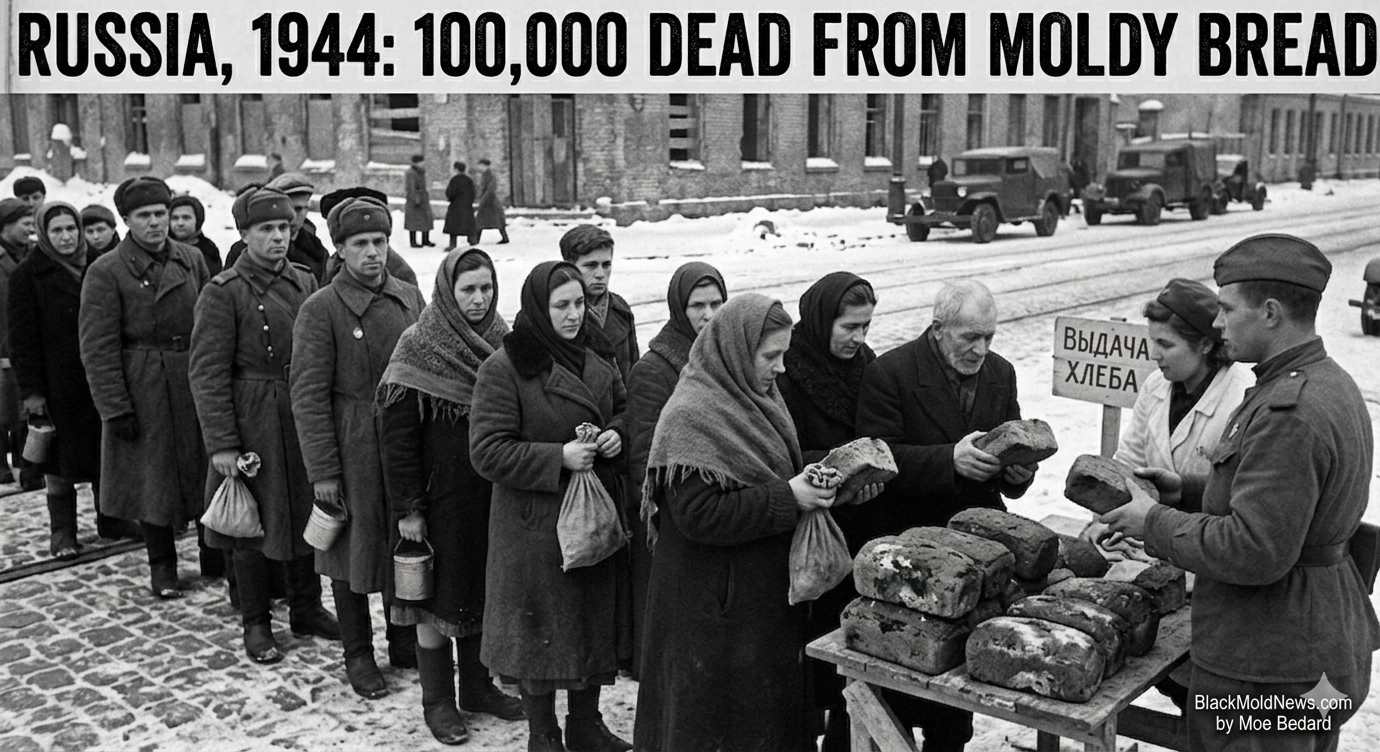
During the peak of World War II, a mass poisoning swept through the Orenburg District of the Soviet Union and wider Siberian regions, killing tens of thousands of civilians. The culprit was not a bomb, not a pathogen, and not a political enemy.
It was mold — a Fusarium fungus growing silently on overwintered grain — producing one of the most potent natural toxins ever to enter a human food supply.
Medical researchers named the resulting condition Alimentary Toxic Aleukia, or ATA. The event remains one of the largest recorded mass mycotoxin poisoning events in human history, and it carries urgent lessons about what happens when food security collapses and mold is allowed to win.
Researchers first documented the disease as far back as 1891 in the Ussuri District of eastern Siberia, where stored grain was infected with toxin-producing Fusarium. Early outbreaks continued through the 1930s, particularly beginning in 1932 in the Orenburg Oblast of the former USSR.
But the catastrophic peak came during World War II.
World War II stretched Soviet agriculture to the absolute breaking point. Men of working age were drafted into military service. Equipment and fuel were redirected to the front. Fields that would normally be harvested in autumn were left unattended, grain stalks standing through brutal Russian winters — frozen under snow for months at a time.
When spring came and desperate survivors finally gathered that grain, they did not understand what the cold, wet months had done to it. The Orenburg District, a wide agricultural region east of the Ural Mountains, was especially hard hit.
According to a declassified CIA document on mycotoxins and the Soviet connection, over 10 percent of the entire population of the Orenburg District died of the disease.
Numerous other outbreaks of ATA occurred in the Soviet Union primarily between 1942 and 1947.
The peak year was 1944. According to research published in Toxins by Agriculture and Agri-Food Canada researchers Foroud and Baines, the number of registered ATA cases reached 173,000 in 1944 alone, of which approximately 28,000 people died — a mortality rate of roughly 16 percent at the outbreak’s recorded peak.
Wikipedia’s entry on trichothecenes cites figures of around 100,000 affected individuals across the outbreak with a 60 percent mortality rate in severe cases.
Mortality across different outbreak zones ranged from 17 to 50 percent depending on how contaminated the grain supply was and how malnourished the population had become.
As the JAMA Network noted in a published letter, “Mycotoxin produced by a species of Fusarium and possibly other genera were responsible for toxic alimentary aleukia and resulting death in humans in Russia in 1944 after the victims ate bread prepared from infested grain which had wintered in the field.”
The Science: What the Mold Was Doing
The molds responsible for this catastrophe were Fusarium sporotrichioides and Fusarium poae. Both are members of the Fusarium genus — field molds that thrive in cold, wet conditions.
Under normal harvest conditions, these molds have limited opportunity to colonize grain at dangerous levels. But grain left through a Russian winter becomes the perfect substrate.
These molds produced a mycotoxin called T-2 toxin, a member of the trichothecene family of mycotoxins. T-2 toxin is classified as a Type A trichothecene — a group of sesquiterpenoid compounds that attack the fundamental machinery of living cells.
According to NIH-published research in Toxins (2019), trichothecenes bind directly to the 60S ribosome and are potent inhibitors of eukaryotic protein synthesis.
In plain terms, T-2 toxin shuts down the body’s ability to make new proteins — attacking the immune system, bone marrow, gastrointestinal lining, and blood-clotting mechanisms simultaneously.
Researchers have compared the symptoms of ATA to radiation sickness, because the most prominent outcome is a catastrophic drop in white blood cells — a condition called leukopenia, or aleukia. Without white blood cells, the body cannot fight infection. Without platelets, it cannot stop bleeding.
The U.S. Environmental Protection Agency notes that mold growth in grain can begin rapidly under the right temperature and moisture conditions, and T-2 toxin-producing Fusarium species are particularly well-adapted to cold environments where other organisms might not compete.
The snow-covered fields of Orenburg created almost ideal conditions for these molds to colonize grain over months, loading the harvest with extraordinarily high toxin levels by the time spring arrived.
According to a preliminary CIA scientific review, levels of trichothecene toxin detected in toxic grain implicated in these events typically ranged between 2 and 8 parts per million — and some Soviet researchers reported production of T-2 toxin at levels as high as 4 grams per kilogram of substrate.
The Four Stages of Death
Understanding what ATA actually did to the human body reveals the horror of this event in clinical detail.
Researchers who documented the 1944 outbreak described ATA progressing through four distinct stages.
1. Stage One began within hours of eating contaminated bread. Victims experienced a bitter taste in the mouth, numbness of the tongue, a burning sensation in the throat, weakness, sweating, and pain throughout the body.
If the person stopped eating the contaminated grain, these symptoms could temporarily subside. But with no other food available, people kept eating.
2. Stage Two was the leukopenia phase — the collapse of the immune system. White blood cell counts plummeted. Patients became profoundly fatigued, dizzy, and pale. A petechial rash — tiny hemorrhagic spots — began appearing on the skin, signaling that internal bleeding had started. This stage could last two weeks to three months.
3. Stage Three was the deadly phase. According to the Wikipedia documentation of ATA’s clinical course, this stage brought massive hemorrhaging from the nose, throat, esophagus, gut, kidneys, bladder, and uterus.
Patients developed necrotic angina — the tonsils and throat tissues literally decomposed. Gangrene spread to the soft palate, gums, tongue, lips, and cheeks. Teeth fell out. Cheeks perforated. Children and malnourished individuals died most quickly. Heart paralysis, pulmonary hemorrhage, pneumonia with lung abscesses, and suffocation all contributed to death in Stage Three.
4. Stage Four, for those who survived, was a slow and incomplete recovery — with lasting damage to the heart, liver, nervous system, and gastrointestinal tract.
According to declassified U.S. government records, trichothecenes figured prominently in Soviet scientific literature from the 1940s onward precisely because of this disaster.
The Soviet scientific community was deeply motivated to understand these toxins, which later led to international controversy in the 1980s when the U.S. Secretary of State accused the Soviet Union of weaponizing T-2 toxin in Southeast Asia — the so-called “Yellow Rain” controversy.
Conclusion
The deaths in Russia’s Orenburg District in 1944 were not caused by a military weapon or an infectious epidemic.
They were caused by moldy bread — by Fusarium mold that turned overwintered grain into a vehicle for one of the most potent mycotoxins ever to enter a human food supply.
Tens of thousands of civilians died from ATA during the peak of World War II, with 173,000 cases registered in 1944 alone.
Mortality in the most severe outbreak zones exceeded 50 percent. The disease attacked the immune system, the blood, the throat, and the organs until the body could no longer function.
What makes this event permanently relevant is its clarity.
It removes any ambiguity about what mycotoxins can do when exposure is prolonged, quantities are high, and the human body is already under stress.
Today’s mold professionals and homeowners are not dealing with the scale of 1944 Orenburg — but the biology is identical.
The same molds, the same toxins, the same mechanisms of harm.
References
-
Foroud NA, Baines D, et al. “Trichothecenes in Cereal Grains – An Update.” Toxins (Basel). 2019 Oct 31;11(11):634. PMC6891312. https://pmc.ncbi.nlm.nih.gov/articles/PMC6891312/
-
“Alimentary Toxic Aleukia.” Wikipedia. https://en.wikipedia.org/wiki/Alimentary_toxic_aleukia
-
“T-2 Mycotoxin.” Wikipedia. https://en.wikipedia.org/wiki/T-2_mycotoxin
-
“Trichothecene.” Wikipedia. https://en.wikipedia.org/wiki/Trichothecene
-
“MYCOTOXINS AND THE SOVIET CONNECTION (U).” CIA Reading Room. https://www.cia.gov/readingroom/document/cia-rdp84b00049r000400830010-1
-
“Pathogenesis of alimentary (toxic) aleukia.” Zh Mikrobiol Epidemiol Immunobiol. 1945:(3):65-70. PubMed PMID: 20984491. https://pubmed.ncbi.nlm.nih.gov/20984491/
-
“Screening of toxic isolates of Fusarium poae and Fusarium sporotrichioides involved in causing alimentary toxic aleukia.” PubMed PMID: 984817. https://pubmed.ncbi.nlm.nih.gov/984817/
-
“Epidemiological features of the mycotoxicoses.” Ann Nutr Aliment. 1977. PubMed PMID: 77650. https://pubmed.ncbi.nlm.nih.gov/77650/
-
JAMA Network letter on alimentary aleukia and leukemia. JAMA. https://jamanetwork.com/journals/jama/fullarticle/350561
-
U.S. Environmental Protection Agency. Indoor Mold Resources. https://www.epa.gov
-
“The Impact of Mycotoxicoses on Human History.” Arh Hig Rada Toksikol. https://hrcak.srce.hr/file/137917
-
Tucker JB. “The Yellow Rain Controversy: Lessons for Arms Control Compliance.” The Nonproliferation Review. https://www.nonproliferation.org/wp-content/uploads/npr/81tucker.pdf


0 Comments