
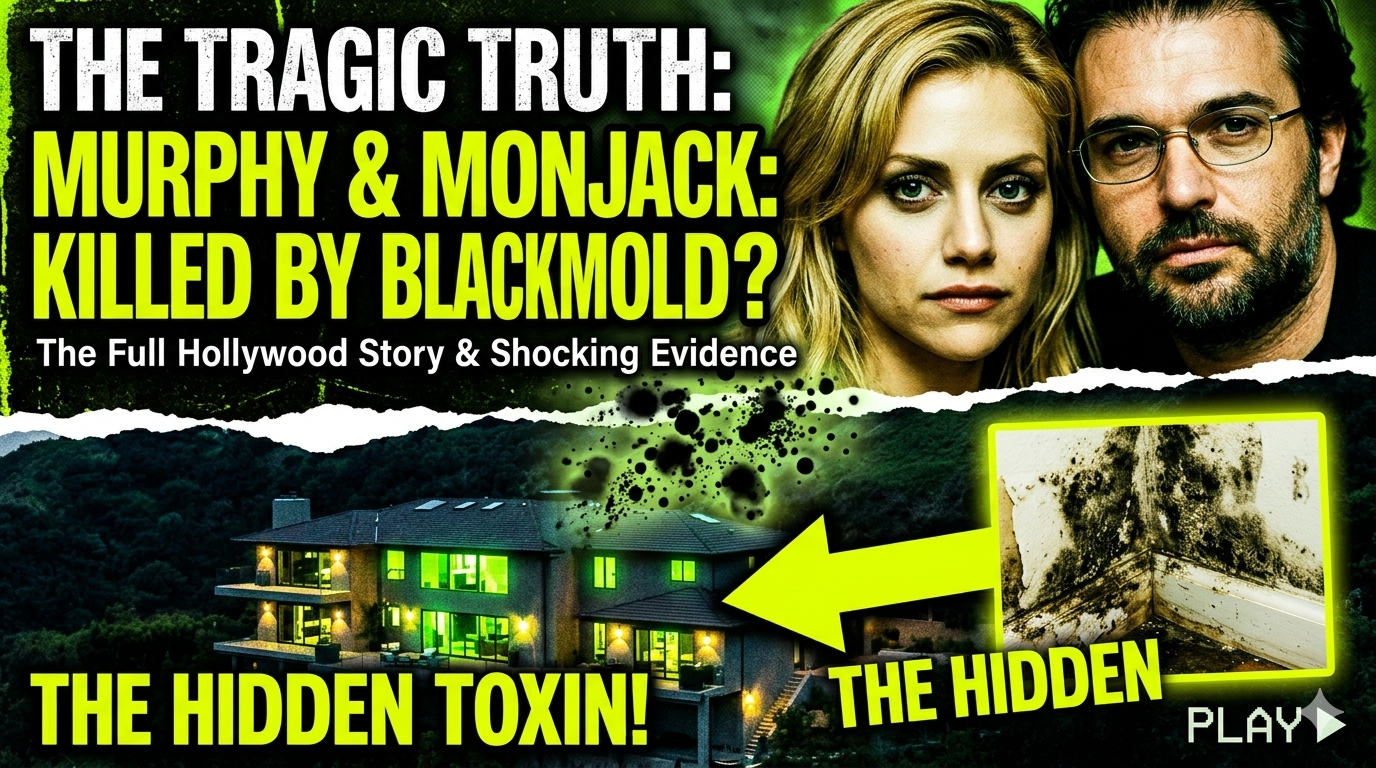
Actress Brittany Murphy died suddenly from pneumonia and anemia in 2009. She was only 32.
Five months later, her husband, Simon Monjack dropped dead from the exact same illnesses. He was just 40.
The Clueless actress and the British screenwriter were both mysteriously found dead in the same house within five months of each other. So, what was hidden within the walls of their multi-million dollar Hollywood Hills home that may have caused these two souls to die at such a young age?
If we are to ask Brittany Murphy’s mother, Sharon Murphy, she had claimed that toxic mold found in Brittany’s luxurious Hollywood home killed her daughter and her son-in-law. She said the builders of the home were to blame for the mold that caused their condition.
This makes perfect sense. After all, mold is toxic and can be deadly. It has been proven in many scientific studies to cause allergies, asthma, pneumonia, and a whole host of various other diseases – including death!
The house sat above the Sunset Strip, a 13‑year‑old mansion that Brittany Murphy had bought from Britney Spears in 2003 for $3.85 million. From the outside, it was a luxury property, the kind that looks like a home for a Hollywood star. From the inside, multiple people reported a persistent leak, water damage, and a sense that something felt “off” about the place.
There is also the fact that Brittany Murphy and Simon Monjack’s home was built in the Hollywood Hills and sat at the bottom of several hills.
Monjack had experienced frequent seizures, asthma, and sleep apnea while living in the home, and had himself investigated whether mold might be a problem before Murphy’s death.
Murphy reportedly frequently said she disliked the house.
Murphy’s husband, Simon Monjack, told the Hollywood Reporter that his wife “absolutely hated” the Rising Glen house.
He recalled: “Every time we would drive up Sunset, Brit would say, ‘Please, can we stay at the Beverly Hills Hotel?’” She reportedly avoided sleeping there when she could, which is a pattern often seen in people who are being silently poisoned by their environment.
Britney Spears, who lived in the same house, reportedly had a deeply unsettling experience there.
According to claims made by her former makeup artist, Julianne Kaye, during a 2021 appearance on the “We Need to Talk About Britney” podcast that Britney Spears fled the home after she was convinced that “bad spirits” were trying to “push her down the stairs.”
“[Spears] had that place up on Sunset Plaza, and I’m just gonna say, this is really weird,” Kaye began. “She calls me… I had my friend do a reiki healing on her. I guess she’d had a crazy partying weekend and needed to relax.
“He left, and she swears to God that he opened some spirit portal or something, and these bad spirits had come in and they were trying to push her down the stairs or something crazy.
“It was so bad that she left. She went to the Casa Del Mar hotel to stay there and never went back to the house. She goes, ‘I know you’re going to think I’m crazy. I’m not crazy. I know what I saw, I know what I felt. She checked out of the house and never stayed there again.”
Spears was said to have never spent another night in the property and ultimately sold it on to Murphy, who, according to her late husband, also had some VERY uncomfortable feelings about the home.
In a 2011 piece about Murphy’s “final difficult days,” The Hollywood Reporter stated that Munjack had claimed his wife believed the home, which is located on Rising Glen Road, was “unlucky” and had been planning to move to New York before her death.
Her former makeup artist told reporters that Spears called her one day, terrified that a “spirit portal” had opened in the home and that “bad spirits” were inside.
Mold professionals and researchers have long noted that mycotoxins from certain molds can cause neurologic and psychological symptoms—dizziness, anxiety, hallucinations, and a sense of “something is wrong” in the building—that can be mistaken for paranormal experiences.
Let me also add that this is the former residence of pop singer Britney Spears back in 2003, while she was dating Justin Timberlake. She sold the home to actress Brittany Murphy in June 2003 for $3,850,000.
A few years later, Spears was in the news for crazy and erratic behavior during which she shaved her head, got two new tattoos, and hit the L.A. club scene with a lot of drama.
Quite possibly this episode was the result of toxic mold poisoning from her former home, which is also a symptom of mold sickness.
It is now known by some people as the cursed Hollywood Hills home.
If you just Google homes at bottom of hill and mold, you will find a plethora of news stories and claims by people whose homes became mold infested from drainage problems.
Check out this image of Brittany Murphy’s and Simon Monjack’s home. You can clearly see their property sits at the bottom of several hills.
Water drains down hill and can easily penetrate a home’s foundation and exterior walls. Drainage and flooding issues that affect homes at the bottom of hills are a common problem.
Initially, it was reported that the Los Angeles County Corner’s Office was going to look at mold as the possible cause of death.
Shortly after her death, assistant chief coroner Ed Winter told the Associated Press: “It appears to be natural.” An autopsy was performed the day after she died. Her death certificate listed the cause of death as “deferred”.
On February 4, 2010, the Los Angeles County coroner stated that the primary cause of Murphy’s death was pneumonia, with secondary factors of iron-deficiency anemia and multiple drug intoxication. The report stated Murphy’s menstrual period contributed to her anemia and left her in a weakened state and vulnerable to infection. It also contributed the effects that a host of drugs, including hydrocodone and acetaminophen.
The report notes that the medications found in Murphy’s system were consistent with treatment of a cold or respiratory infection. Murphy’s mother and husband had reported the actress was ill with flu-like symptoms in the days before her death.
Winter stated further, “It is unusual to have two people die of similar circumstances with pneumonia. We’ve been looking at it and saying, ‘Something isn’t right.’ I’m not saying you can’t get pneumonia from mold, but we did all the tests on it — mold did not come up in the toxicology reports.”
What is interesting, according to the LA County Coroner report, they identified staphylococcus aureus (staph bacteria) in her lungs as a major factor in the pneumonia that caused her death. It also states that “other cultures were positive for additional organisms, which may represent contaminants and/or minor pathogens.”
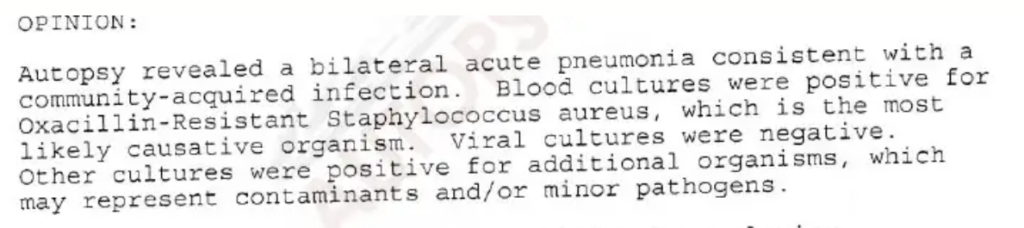
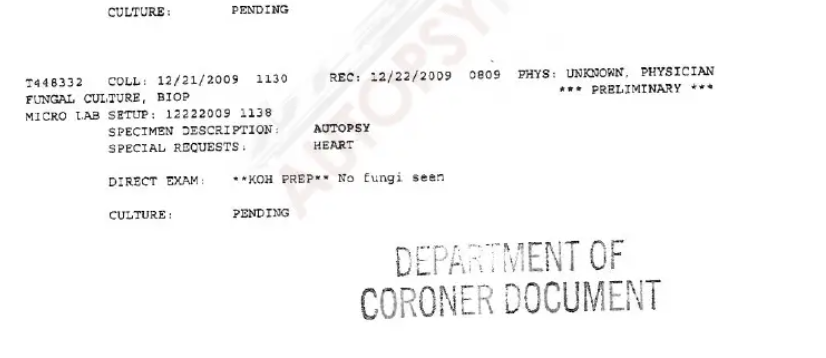
I say this is a BIG PROBLEM because when someone dies of a suspected or unknown lung disease and the case falls under the coroner’s jurisdiction (such as unexpected death, suspicion of infection, or occupational disease), a postmortem lung biopsy or tissue culture is often performed as part of the autopsy.
But NOT in Brittany Murphy’s case.
The autopsy report also noted Murphy suffered from diabetes and had to go to the hospital for treatment in Oregon in April 2009.
Mold illness and fungal infections have also been linked to diabetes.
For example, some research has shown that people with diabetes are more susceptible to fungal infections due to high blood sugar and a weakened immune system. S
ome research suggests that certain components of the gut microbiome, including fungi, may be associated with markers of diabetes.
Candida albicans had been identified as a significant indirect factor induces increased insulin secretion and insulin resistance.
According to several studies, stomach problems can be caused by fungal overgrowth (typically Candida), often stemming from high blood sugar, which fuels fungus and triggers symptoms like abdominal pain, bloating, nausea, diarrhea, and vomiting.
Let me also please note that acccording to the Centers for Disease Control and Prevention (CDC), “for some people, mold can cause a stuffy nose, sore throat, coughing or wheezing, burning eyes, or skin rash. People with asthma or who are allergic to mold may have severe reactions.
Immune-compromised people and people with chronic lung disease may get infections in their lungs from mold.
The CDC stated that “For people who are sensitive to molds exposure to molds can lead to symptoms such as stuffy nose, wheezing, and red or itchy eyes, or skin. Severe reactions, such as fever or shortness of breath, may occur among workers exposed to large amounts of molds in occupational settings, such as farmers working around moldy hay.
In 2004 the Institute of Medicine (IOM) found there was sufficient evidence to link indoor exposure to mold with upper respiratory tract symptoms, cough, and wheeze in otherwise healthy people; with asthma symptoms in people with asthma; and with hypersensitivity pneumonitis in individuals susceptible to that immune-mediated condition.
These are ALL THE EXACT SAME SYMPTOMS Brittany Murphy had complained of before her death!
According to Entertainment Tonight, Brittany Murphy’s estranged biological father, Angelo Bertolotti challenged the results of her autopsy in a 2010 lawsuit against the Los Angeles County Coroner’s Office and the Los Angeles Police Department.
Bertolotti claims “testing/toxicology was incomplete and the death of Brittany Anne Murphy Monjak was never fully investigated” and requested samples of his daughter’s hair for testing.
Bertolotti, who is also suing the Los Angeles Police Department, has requested samples of his daughter’s hair for testing. He believed that tests of Murphy’s hair may show evidence that toxic mold in her Hollywood Hills home could have caused her death, according to The Hollywood Reporter.
“Plaintiff Angelo Bertolotti is the natural father of deceased Brittany Anne Murphy-Monjack, who expired under suspicious circumstances at the age of 32 years old on December 20, 2009,” the pro se complaint states.
“Since the time of death of plaintiff’s daughter, Brittany Anne Murphy-Monjack, plaintiff exhausted all extrajudicial means of ensuring that his daughter’s death is finally and fully investigated.
In spite of his efforts, to date there has been no investigation, none of the potential witnesses and/or persons of interest have been questioned and only very basic autopsy procedures/toxicology testing has been performed.”
In meetings with Chief Coroner Ed Winter and Los Angeles Police Detective Brandstetter, Bertolotti “repeatedly voiced his concerns about these findings being incorrect, since the testing/toxicology was incomplete and the death of Brittany Anne Murphy-Monjack was never properly investigated,” according to the complaint.
“Officials heading the case from the Los Angeles Coroner’s Office and the Los Angeles Police Department admitted that decedent’s hair was never tested,” he says. “Both agencies admitted that toxicology tests were not performed on the hair of Brittany Anne Murphy-Monjack, but refused to ever test her hair and other specimens for any poisons, toxins or heavy metals, as plaintiff repeatedly requested.”
“The Los Angeles Coroner’s Office and Los Angeles Police Department intended to destroy decedent’s specimens, including but not limited to her hair, even though they were not fully and appropriately tested,” the lawsuit states. “Plaintiff made a payment and officially secured the preservation of his daughter’s specimens for 5 years.”
Bertolotti says the pneumonia finding is a result of a “lack of investigative efforts by the Los Angeles Police Department (LAPD) and the failure to conduct toxicology tests on the specimens of the decedent Brittany Anne Murphy-Monjack by the Los Angeles County Coroner’s Office and the LAPD.”
“I’m not going to rest until my daughter’s untimely demise is properly investigated, which hasn’t happened so far. Her case deserves more than a superficial glance,” Bertolotti said in a press release quoted by The Hollywood Reporter.
His suit comes a month after Murphy’s mother, Sharon Murphy, filed a lawsuit against the law firm that represented her in a case involving the actress’ home. Sharon claims the law firm should have advised her against signing a settlement with the builders of the house when they should have known there was toxic mold in the home.
As many people well know who understand the dangers of mold, and/or who have become sick from mold here in the U.S., trying to get the proper testing or any type of toxicology test for mold is almost impossible.
Mold is almost ALWAYS overlooked and/or dismissed by our current U.S. medical system. It is rarely listed as the cause of an illness, disease and/or death.
Just getting a doctor to listen to our stories and/or look further into mold as being a cause of our illnesses is equally impossible.
Mold is treated as if it is harmless. People who get sick from mold are crazy.
It’s as if it doesn’t exist.
So, it is not surprising that “mold illness was never diagnosed and did not come up in the toxicology reports.”
Interestingly, mold illness and fungal infections can cause both pneumonia and anemia – the same illnesses and diseases that Britany Murphy was said to have died from.
Hence, it is not far fetched to claim that the home her and her husband lived in that was known to have water damage and mold may have caused these illnesses in both Murphy and Wonjak.
According to the CDC, Mold exposure can cause serious respiratory issues, including fungal pneumonia, particularly in individuals with weakened immune systems, underlying lung disease, or allergies.
The CDC states that people with weakened immune systems can get invasive mold infections (IMIs). These are mold infections that affect blood vessels, deep tissues, or organs.dampness and mold can cause coughing, wheezing, and hypersensitivity pneumonitis, a non-infectious lung inflammation. Common fungal pneumonias include histoplasmosis, blastomycosis, and Valley fever.
Could this just be another tragic case of misdiagnosis of a mold infection and a Corner who also failed to recognize the tale-tale signs?
Mold Mentions in the Record
Long before Murphy and Monjack died, mold was already in the public record.
In 2006, Murphy and her mother Sharon filed a lawsuit against the home’s builder and subcontractors, citing construction defects and alleging the presence of toxic mold linked to water leaks and poor materials.
The couple settled that lawsuit for $600,000 in early 2011, after the deaths.
What Murphy’s mother later claimed was that the lawyers who handled the case never properly informed her that accepting the settlement would give up her right to sue for wrongful death related to mold exposure, which is why she later filed a legal‑malpractice complaint against them.
After Murphy’s death, the Los Angeles County Department of Health briefly considered toxic mold as a possible factor in the couple’s fatal pneumonia cases, given that two people died of respiratory illness in the same home within months.
In 2011, Scarborough–Mold environmental consultant Roger Neal, who represented the family, told media that the house had been tested by “a well‑respected company” for dangerous mold just two months before Murphy’s death, and that the report came back “mold‑free.”
He also said that Monjack himself had ordered a full house inspection in October 2009 that found no mold danger, and had assured Sharon that the house was safe.
Despite those tests, the families insisted that something was still wrong.
Murphy’s mother, Sharon Murphy, initially dismissed the idea that mold contributed to her daughter’s death, calling it “absurd” in 2010. But by late 2011, she had changed her position completely. In a new lawsuit filed against her attorneys, she claimed that toxic mold in the house was the cause of both Brittany and Simon Monjack’s deaths.
She alleged that when she accepted the $600,000 settlement, she was never told she would be forfeiting her right to sue for wrongful death related to mold.
In an emotional open letter published by the Hollywood Reporter in 2013, she pushed back against theories that her daughter was poisoned by a third party, but she kept the mold angle alive, writing that “one possible cause of Brittany’s death that has come to light is toxic mold found in her home,” which she said may have significantly contributed to her passing.
On the other side, Simon Monjack’s mother, Linda Monjack, told the Daily Mail that her son had discovered “severe mold” in the house before he died and that he began experiencing hallucinations.
She said, “All I know is that before Simon’s death, he was having hallucinations that things were crawling out of his skin.”
Those statements—flu‑like symptoms, pneumonia, anemia, and hallucinations in an older, leaky house—are exactly the kind of pattern that many building biologists and environmental medicine practitioners see in chronic mold‑illness cases, even if the coroner’s office does not list mold as a direct cause of death.
Please keep in mind the previous incidents with Brittany Spears and to this day, she is still having mental issues. Perhaps she never treated the root cause – mold within her body?
How Mold Illness Could Still Fit the Picture
Even with those official statements, the mold‑illness theory is not as far‑fetched as it might sound.
Medical examiners typically look for acute fungal infection or mycotoxins in blood and tissue at the time of death.
If a person has been exposed to mold for years, but the main cause of death is pneumonia and anemia, the coroner may not code mold as a contributing factor—even if it has weakened the immune system over time.
Chronic mold exposure can:
-
Lower white‑blood‑cell counts and impair immune response, making it harder to fight off a lung infection.
-
Cause chronic inflammation and oxidative stress, which are linked to heart strain and other organ stress.
-
Produce neurotoxic effects that explain hallucinations, paranoia, and “crawling” sensations, especially in people who are already under stress or have co‑existing health issues.
In Murphy’s case, the combination of anemia, pneumonia, and possible immune suppression from long‑term mold exposure could have created a perfect storm. The same would be true for Monjack, who lived in the same house and reportedly saw visible mold and had hallucinations before his death.
All the Public Mentions of Mold in This Case
Here is a clear list of every documented mention of mold in the Brittany Murphy–Simon Monjack story, as reported in mainstream and investigative sources:
1 – 2006 lawsuit against the builder – Murphy and Sharon Murphy filed suit against the home’s builder and subcontractors, alleging construction defects and the presence of toxic mold due to water damage and poor materials.
2 – Post‑death mold speculation – After Murphy’s death, rumors circulated that toxic mold in the house may have contributed to her pneumonia and passing.
3 – Health department inquiry – The Los Angeles County Department of Health briefly considered toxic mold as a possible cause of the deaths because two people died of pneumonia in the same house within months.
4 – Murphy’s mother’s reversal – Sharon Murphy first called the mold theory “absurd” in 2010, then in 2011 filed a lawsuit against her former attorneys, claiming that toxic mold in the house caused both Brittany and Simon Monjack’s deaths.
5 – Mold‑testing report cited by family spokesperson – Family rep Roger Neal stated that a “well‑respected” company tested the house for mold two months before Murphy’s death and found no mold danger, and that Monjack had ordered a full inspection that also came back mold‑free.
6 – Monjack’s mother’s statements – Linda Monjack told the Daily Mail that her son found “severe mold” in the house before he died and that he was experiencing hallucinations, including the feeling that things were crawling out of his skin.
7. Public‑health‑office conclusion – In 2010, the coroner’s office concluded that there were “no indicators” that mold was a factor in the deaths, even though the house was eventually reported to the Department of Public Health as a precaution.
8 – Later media commentary – Home‑improvement and mold‑remediation blogs have repeatedly cited the case under titles like “Toxic Mold Could Have Had a Part in Brittany Murphy’s Death,” arguing that mold may have weakened the couple’s health and contributed to their fatal pneumonia.
Each of these mentions feeds into the same narrative: mold was visible or suspected in the house; the victims lived there for years; and both died of pneumonia and anemia in the same location, shortly after one another.
Why Mold Illness Fits the Pattern So Well
The Brittany Murphy–Simon Monjack deaths follow a pattern that many mold‑exposure experts recognize in “mold houses”:
-
Chronic exposure to dampness and leaks – The house had a persistent leak and construction defects, creating ongoing water damage and humidity.
-
Unexplained physical decline – Both Murphy and Monjack reportedly suffered from fatigue, flu‑like illness, and breathing problems, symptoms that overlap heavily with chronic mold‑related illness.
-
Neurologic and psychiatric symptoms – The hallucinations and “crawling” complaints described by Linda Monjack are consistent with reports from people exposed to certain mycotoxins, especially in poorly ventilated, moldy homes.
-
Two deaths with the same diagnoses in one house – The coroner himself called it “unusual” that two people would die of pneumonia and anemia in the same residence within months of each other.
Even if mold never appears on a death certificate, it can still be a hidden contributor in a person’s health trajectory.
The deaths of Brittany Murphy and Simon Monjack are a powerful reminder that what we do not see in the air of our homes can still have very real consequences.
For anyone living in a house with water damage, a musty smell, or a sense that something is “off” in the environment, their story is a cue to investigate, remediate, and, if needed, walk away—before the next symptom is something far worse than a cough or a headache.
References
Here are the key sources for the Brittany Murphy–Simon Monjack mold‑poisoning discussion, formatted as clickable links:
-
People.com – Brittany Murphy’s Death, 16 Years Later – overview of official causes and surrounding rumors.
-
ABC News – “Brittany Murphy and Husband Simon Monjack Died of Similar Causes” – coroner’s statements on mold not being a factor and comments on the unusual pattern of two pneumonia deaths in one house.
-
MVP Mold – “Toxic Mold Could Have Had a Part in Brittany Murphy’s Death” – detailed timeline of events, family statements, and claims about mold exposure.
-
Stern Mold – “Could Mold Have Caused the Death of Brittany Murphy?” – background on the 2006 lawsuit and later developments involving mold claims.
- Brittany Murphy Corner Report
-
Wikipedia – “Brittany Murphy” – summary of death details and public‑health‑office dismissals of mold as a cause.
-
Oxygen / True Crime Buzz – “Three Rumors Circulating Since Brittany Murphy’s Death” – discussion of mold, poisoning, and other conspiracy theories.
-
Hollywood Reporter – “Shocking New Brittany Murphy Claim Says Toxic Mold May Have …” – coverage of Sharon Murphy’s mold‑related lawsuit and allegations.
-
Purely Green Enviro – “A Moldy Home, a Flu‑Like Illness and the Deaths of Brittany Murphy and Simon Monjack” – analysis of how mold may have contributed to their deaths despite the coroner’s findings.
-
CNN – “Cold medicines contributed to Brittany Murphy’s death, coroner says” – detailed account of the coroner’s ruling on pneumonia, anemia, and drugs.
-
Reuters – “Brittany Murphy died from pneumonia, anemia, drugs” – official summary of the coroner’s cause of death.
-
People.com – “Husband Died from Same Causes as Brittany Murphy” – coverage of Simon Monjack’s death from pneumonia and severe anemia.
-
CNN – “Coroner finds Simon Monjack’s death was similar to Brittany Murphy’s” – additional details on the coroner’s report for Monjack.
-
International Business Times – “Brittany Murphy Death Case Update: Poisoning Evidence Could Reopen Investigation Experts Say” – discussion of poisoning theories and the mother’s mold claims.
- Realtor.com – ‘Cursed’ Home Where Brittany Murphy Died and Britney Spears Encountered ‘Bad Spirits’ Hits the Market for $18 Million


0 Comments